


Understanding worry
This worksheet is designed to facilitate the delivery of psychoeducation about worry. It is intended to facilitate conversations with clients about the evolutionary purpose of worry, as well as precipitating and predisposing factors.
Psychoeducation in CBT helps plays an important role in normalising difficulties, with some research (Donker et al., 2009) suggesting that, on its own, it can be effective in reducing symptoms of psychological distress.
Free

Understanding worry
Free
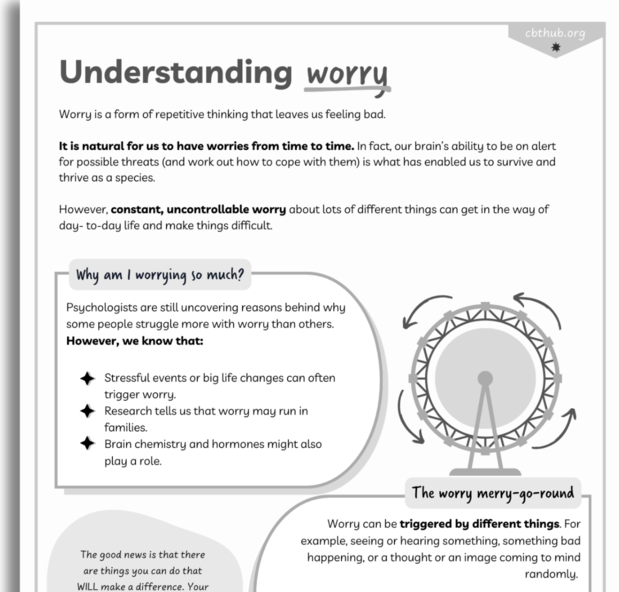
Understanding worry
References and Further Reading
- Dugas, M., & Robichaud, M. (2007) Cognitive-behavioural treatment for generalized anxiety disorder. New York. Routledge.
- Davey, G.C.M & Wells, A. (Eds.) 2006. Worry and its psychological disorders. Theory, assessment and treatment. Sussex. Wiley.
- Calear, A.L., Batterham, P.J., Torok, M. et al.Help-seeking attitudes and intentions for generalised anxiety disorder in adolescents: the role of anxiety literacy and stigma. Eur Child Adolesc Psychiatry 30, 243–251 (2021). https://doi.org/10.1007/s00787-020-01512-9.
- Donker, T. et al. (2009) ‘Psychoeducation for depression, anxiety and psychological distress: A meta-analysis’, BMC Medicine, 7(1). doi:10.1186/1741-7015-7-79.
- Morgado T, Lopes V, Carvalho D, Santos E. The Effectiveness of Psychoeducational Interventions in Adolescents’ Anxiety: A Systematic Review Protocol. Nursing Reports. 2022; 12(1):217-225. https://doi.org/10.3390/nursrep12010022.