


Catching your worries (worry diary 1)
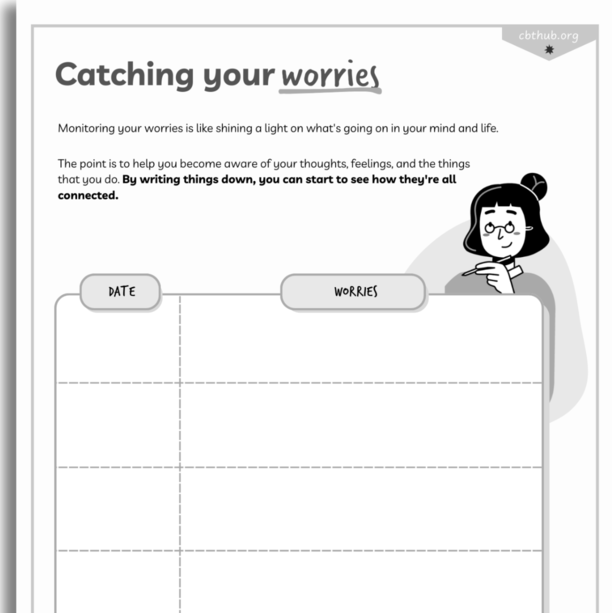
This worksheet assists young people to record their worries in a simple way, including only two columns: “date” and “worries”. It is created for young people who may have limited insight into other aspects of their experience or limited writing abilities.
Self-monitoring is a crucial skill in CBT, enhancing patient awareness of cognitive, emotional, and behavioural patterns and their connections. It also helps identify unhelpful thoughts and behaviours (e.g. Cohen et al., 2013).
Free

Catching your worries (worry diary 1)
Free
Catching your worries (worry diary 1)
References and Further Reading
- Proudfoot, J., & Nicholas, J. (2010). Monitoring and evaluation in low intensity CBT interventions. Oxford guide to low intensity CBT interventions, 97-104.
- Craske, M. G., & Tsao, J. C. I. (1999). Self-monitoring with panic and anxiety disorders. Psychological Assessment, 11(4), 466–479. https://doi.org/10.1037/1040-3590.11.4.466.
- Cohen, J.S., Edmunds, J.M., Brodman, D.M., Benjamin, C.L., Kendall, P.C. (2013). Using self-monitoring: implementation of collaborative empiricism in cognitive-behavioral therapy. Cognitive and Behavioral Practice, 20(4), 419-428.