


Worry: What’s it like?
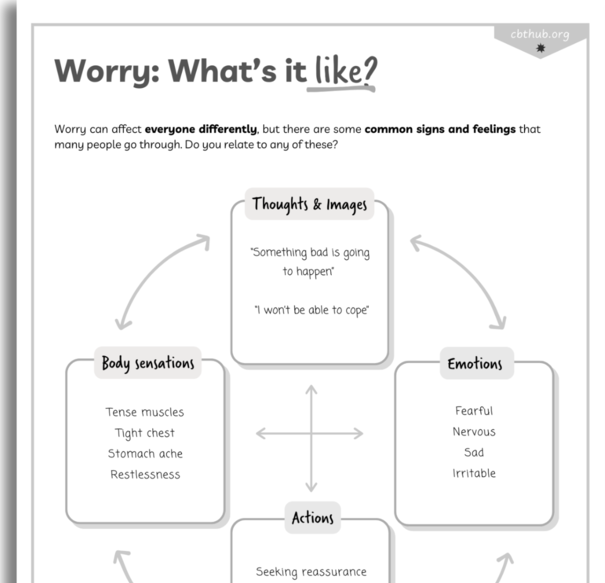
This worksheet outlines some physical, cognitive, and behavioural symptoms of worry within a Five Areas Formulation.
It is designed to facilitate the delivery of worry-related psychoeducation and help therapists foster discussions about the young person’s unique formulation.
Free

Worry: What’s it like?
Free
Worry: What’s it like?
References and Further Reading
- Padesky, C. A., Mooney, K. A. (1990). Presenting the cognitive model to clients.International Cognitive Therapy Newsletter, 6, 13-14.
- Davey, G.C.M & Wells, A. (Eds.) 2006. Worry and its psychological disorders. Theory, assessment and treatment. Sussex. Wiley.
- Dugas,M., & Robichaud, M. (2007) Cognitive-behavioural treatment for generalized anxiety disorder. New York. Routledge.
- Calear, A.L., Batterham, P.J., Torok, M. et al.Help-seeking attitudes and intentions for generalised anxiety disorder in adolescents: the role of anxiety literacy and stigma. Eur Child Adolesc Psychiatry 30, 243–251 (2021). https://doi.org/10.1007/s00787-020-01512-9.
- Donker, T. et al. (2009) ‘Psychoeducation for depression, anxiety and psychological distress: A meta-analysis’, BMC Medicine, 7(1). doi:10.1186/1741-7015-7-79.
- Morgado T, Lopes V, Carvalho D, Santos E. The Effectiveness of Psychoeducational Interventions in Adolescents’ Anxiety: A Systematic Review Protocol. Nursing Reports. 2022; 12(1):217-225. https://doi.org/10.3390/nursrep12010022.