


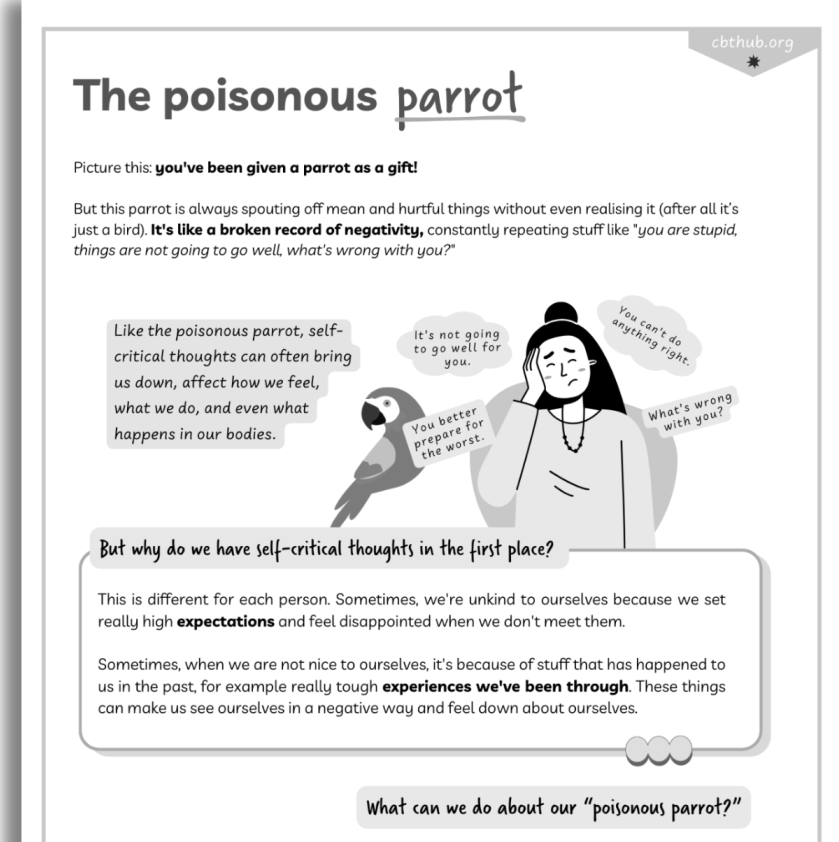
The poisonous parrot
This worksheet is designed to help young people gain perspective on self-critical thoughts by personifying them as a “poisonous parrot.” It supports therapists in guiding young people to recognise this unhelpful inner voice, often filled with negative self-talk, and encouraging them to create some distance from it.
By viewing these thoughts as coming from an external, attention-seeking parrot, young people can learn strategies to acknowledge but not feed this inner critic. Over time, this approach aims to lessen the impact of self-criticism and encourage a more balanced, positive self-view.

References and Further Reading
- Neff, K. D., & McGehee, P. (2009). Self-compassion and psychological resilience among adolescents and young adults. Self and Identity, 9(3), 225–240. https://doi.org/10.1080/15298860902979307.
- Wakelin, K. E., Perman, G., & Simonds, L. M. (2021). Effectiveness of self-compassion-related interventions for reducing self-criticism: A systematic review and meta-analysis. Clinical Psychology & Psychotherapy.
- Bluth, K., & Eisenlohr-Moul, T. (2017). Making friends with yourself: A mixed-methods pilot study of a mindful self-compassion program for adolescents. Mindfulness, 8(6), 1601–1615. https://doi.org/10.1007/s12671-017-0736-y.