


When we talk about making therapy more effective, we often focus on models, techniques, and interventions. But there is something quieter — and just as influential — shaping how therapy is experienced: the language we use.
This is especially true when we consider written materials. CBT worksheets, handouts, and task sheets are often treated as neutral tools, yet the words on the page are part of the therapeutic relationship. They can invite engagement, reduce threat, and support agency — or they can increase avoidance, self-criticism, and disengagement.
Whilst most clinicians are highly attuned to their spoken language in sessions, written language is often given less attention. In busy services, resources are frequently shared, adapted, or reused without revisiting whether the language still fits the young person sitting in front of us.
For children and young people experiencing low mood, anxiety, or overwhelm, this matters more than we might realise.
Language as a Therapeutic Process, Not Just a Delivery Tool
Written language does more than communicate information. It shapes how a young person understands themselves, the task, and their role in therapy.
From a CBT perspective, language can:
- Increase or reduce avoidance
- Amplify or soften self-criticism
- Add to or ease cognitive load
- Subtly reinforce beliefs such as “I can’t do this” or “therapy isn’t for people like me”
When resources are unclear, overly clinical, or densely worded, the difficulty a young person experiences may not be with the intervention itself, but with how it is presented. This can easily be misread as low motivation, lack of engagement, or resistance.
In this sense, written language is not neutral. It is actively shaping the conditions in which therapeutic change can — or cannot — occur.
Why Language in CBT Resources for Children Matters
We know from both research and practice that language carries emotional weight. It can include and reassure, or confuse and alienate.
Most of us will recognise the experience of receiving a healthcare letter full of jargon — something that needs rereading, translating, or mentally filing away for later. For children and young people, particularly those already feeling uncertain or inadequate, this experience can be even more distancing.
Research consistently shows that:
- Plain, accessible language improves understanding and recall. Materials written at a lower reading age (around 11–13 years) are more likely to be understood and used (Doak et al., 1996; NICE, 2023).
- A supportive, collaborative tone increases engagement and reduces feelings of being judged or scrutinised (Lester & Glasby, 2010).
- Avoiding jargon and over-complication helps remove barriers, particularly for those experiencing emotional distress, cognitive overload, or previous exclusion from education or services (Hansen et al., 2021).
These findings are not about simplifying therapy. They are about matching language to cognitive and emotional capacity — a core principle of developmentally informed CBT.

The Impact on Engagement and Therapeutic Outcomes
The language we use — spoken and written — plays a powerful role in shaping the therapeutic relationship.
Studies suggest that overly clinical or expert-driven language can unintentionally reinforce power imbalances, leaving clients feeling confused, passive, or disconnected from the work (Sutherland et al., 2010; Sue & Sue, 2016). This is particularly relevant when working with children and young people, where confidence and agency are still developing.
In contrast, language that feels accessible, collaborative, and human can:
- Support psychological safety
- Increase willingness to try
- Reduce avoidance of tasks
- Strengthen a sense of “this is something I can do”
Written resources that feel understandable and achievable are more likely to support learning, skill use, and behaviour change beyond the session (CBRHL, 2020).
From this perspective, language is not just about clarity — it is part of how therapy becomes usable in real life.
A Reflection on How Resources Are Created
As digital therapy resources become more widely available, many are now produced rapidly and at scale. In some cases, materials are generated with minimal clinician involvement or limited input from the children and young people who are expected to use them.
This raises an important clinical question.
If language is part of the therapeutic relationship, how well can it support safety, engagement, and confidence when it has not been shaped by real therapeutic encounters, supervision reflections, or feedback from young people themselves?
Small phrasing choices — a question that feels evaluative, an instruction that assumes capacity, a tone that sounds distant or directive — can have a disproportionate impact on engagement, particularly for young people who already feel overwhelmed, inadequate, or unsure of themselves.
This is not a critique of technology or innovation. Digital tools can increase access and flexibility in important ways. Rather, it is a reminder that effective therapy resources are rarely created in a single pass. They are refined through use, conversation, missteps, and learning — informed by how real people respond, not just how content reads in theory.
Writing CBT Resources as a Formulation Choice
How we write therapy materials is not just a stylistic decision. It is a formulation decision.
When choosing or creating resources, clinicians might usefully ask:
- What does this young person need this language to do?
- Is this wording reducing threat, or unintentionally increasing it?
- How might this land for someone already feeling behind, different, or “bad at therapy”?
- Does this language support agency, or does it quietly reinforce difficulty?
For some young people, small shifts in wording can be the difference between engaging with a task and avoiding it entirely. This is particularly relevant when motivation is low, confidence is fragile, or previous experiences of learning have been difficult.
Practical Reflections for Writing and Choosing Resources
Whether you are writing your own materials or selecting resources to use in practice, the following considerations can help ensure language supports — rather than hinders — therapeutic work:
- Keep it simple: Short sentences and everyday words reduce cognitive load.
- Speak to the reader: Using “you” helps resources feel personal and relational.
- Normalise experience: Frame emotions and difficulties as understandable human responses, not deficits.
- Separate effort from outcome: Language that values trying reduces fear of failure.
- Build confidence: Highlight skills, strengths, and possibilities, not just problems.
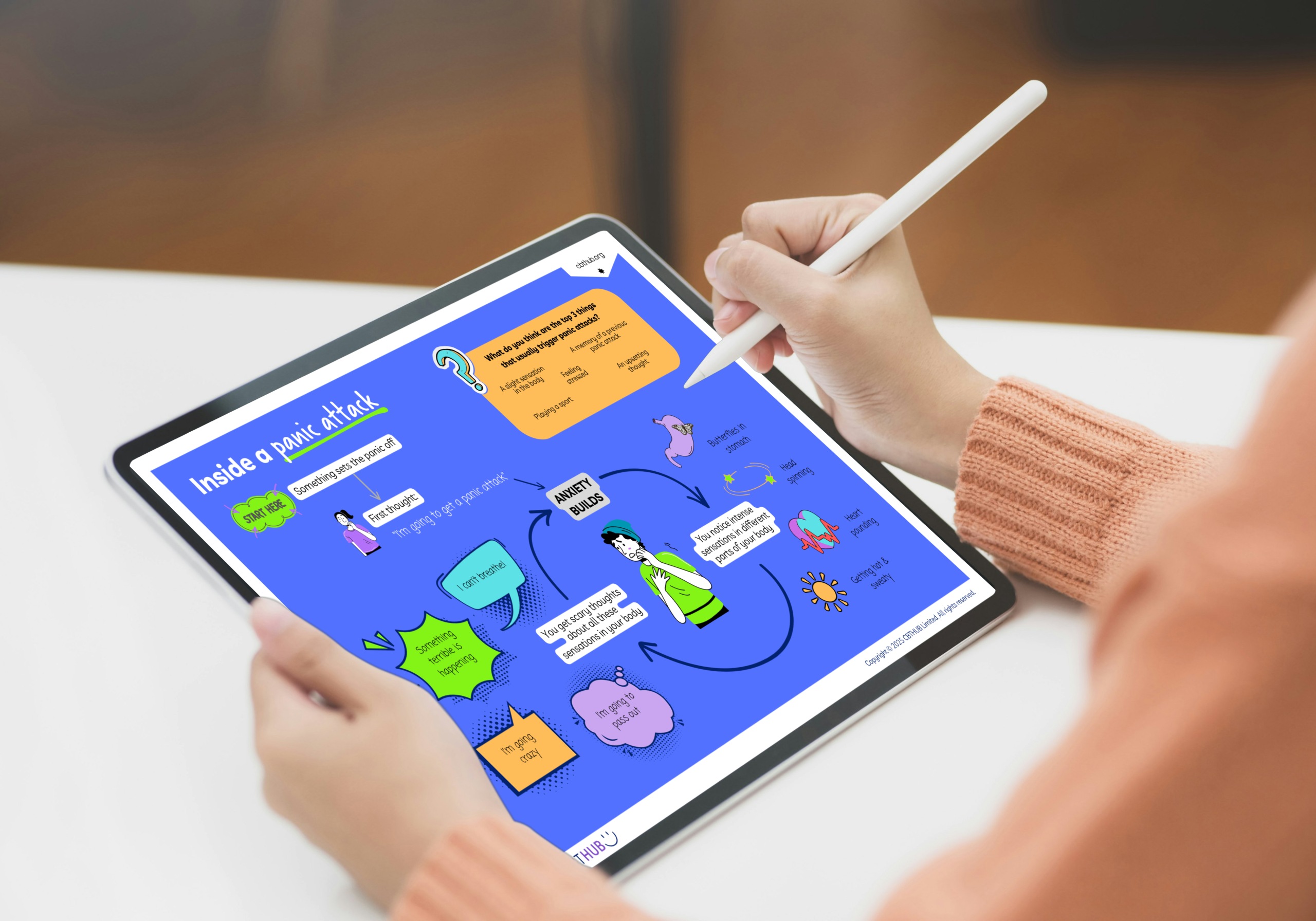
- Show as well as tell: Examples, metaphors, and visuals can make abstract ideas more concrete and less intimidating.
These choices help position resources as invitations rather than tests — something to explore, not get right.
Concluding Thoughts
Language is not just how we deliver therapy — it is part of the intervention itself.
The words we choose shape how safe a resource feels, how relevant it seems, and whether a young person trusts it enough to engage. When written materials are clear, collaborative, and developmentally attuned, they support the same aims we hold in the therapy room: connection, agency, and meaningful change.
Attending to language is not an extra task or a finishing touch. It is part of doing careful, compassionate, effective CBT with children and young people.
Because every worksheet, handout, or task sheet is another moment of relationship — and another opportunity to reduce barriers rather than add to them.
References & Further Reading
Doak, C., Doak, L., & Root, J. (1996). Teaching Patients with Low Literacy Skills. J.B. Lippincott.
NICE (2023). Guided self-help digital CBT for children and young people.
Lester, H., & Glasby, J. (2010). Mental health policy and practice. Palgrave Macmillan.
Hansen, L. et al. (2021). Therapeutic language and client engagement. Clinical Psychology Forum.
CBRHL (2020). Health Literacy: How to Write Patient Materials.
Anderson, H., & Goolishian, H. (1992). The client is the expert. In Therapy as Social Construction.
Heritage, J., & Maynard, D. (2006). Communication in medical care. Cambridge University Press.
Rolvsjord, R. (2010). Therapeutic use of music in mental health care. Music and Arts in Action.
Sue, D. W., & Sue, D. (2016). Counseling the Culturally Diverse. Wiley.
Sutherland, O., Strong, T., & Sherry, J. (2010). Therapists’ accounts of working with depression. Psychotherapy Research.