


Comparing yourself to others
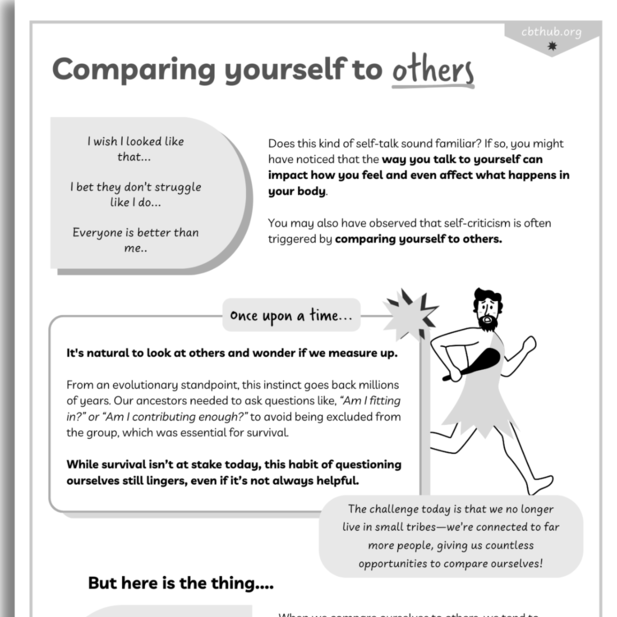
This worksheet is designed to help young people understand the impact of comparing themselves to others. It explains how comparison is a natural, instinctual behaviour rooted in human evolution, but highlights that in today’s world of constant connection, it can lead to unhelpful self-criticism.
Through relatable examples, the handout encourages young people to recognise when they are engaging in negative self-talk triggered by comparisons, and reminds them that everyone faces struggles, even if they aren’t visible.
Free

Comparing yourself to others
Free
Comparing yourself to others
References and Further Reading
- Goodman, F. R., Kelso, K. C., Wiernik, B. M., & Kashdan, T. B. (2021). Social comparisons and social anxiety in daily life: An experience-sampling approach. Journal of Abnormal Psychology, 130(5), 468–489. https://doi.org/10.1037/abn0000671.
- Gallagher, S. M. (2017). The influence of social media on teens’ self-esteem (Publication No. 10284856) [Master’s thesis, Rowan University]. ProQuest Dissertations & Theses Global.
- Scully, M., Swords, L., & Nixon, E. (2020). Social comparisons on social media: Online appearance-related activity and body dissatisfaction in adolescent girls. Developmental Science. Published online by Cambridge University Press. https://doi.org/10.1111/desc.13005.
- Stiles, B. L., & Kaplan, H. B. (2004). Social Behavior and Personality: An International Journal, 32(1), 31–44. https://doi.org/10.2224/sbp.2004.32.1.31.