


Developing a Compassionate Inner Voice
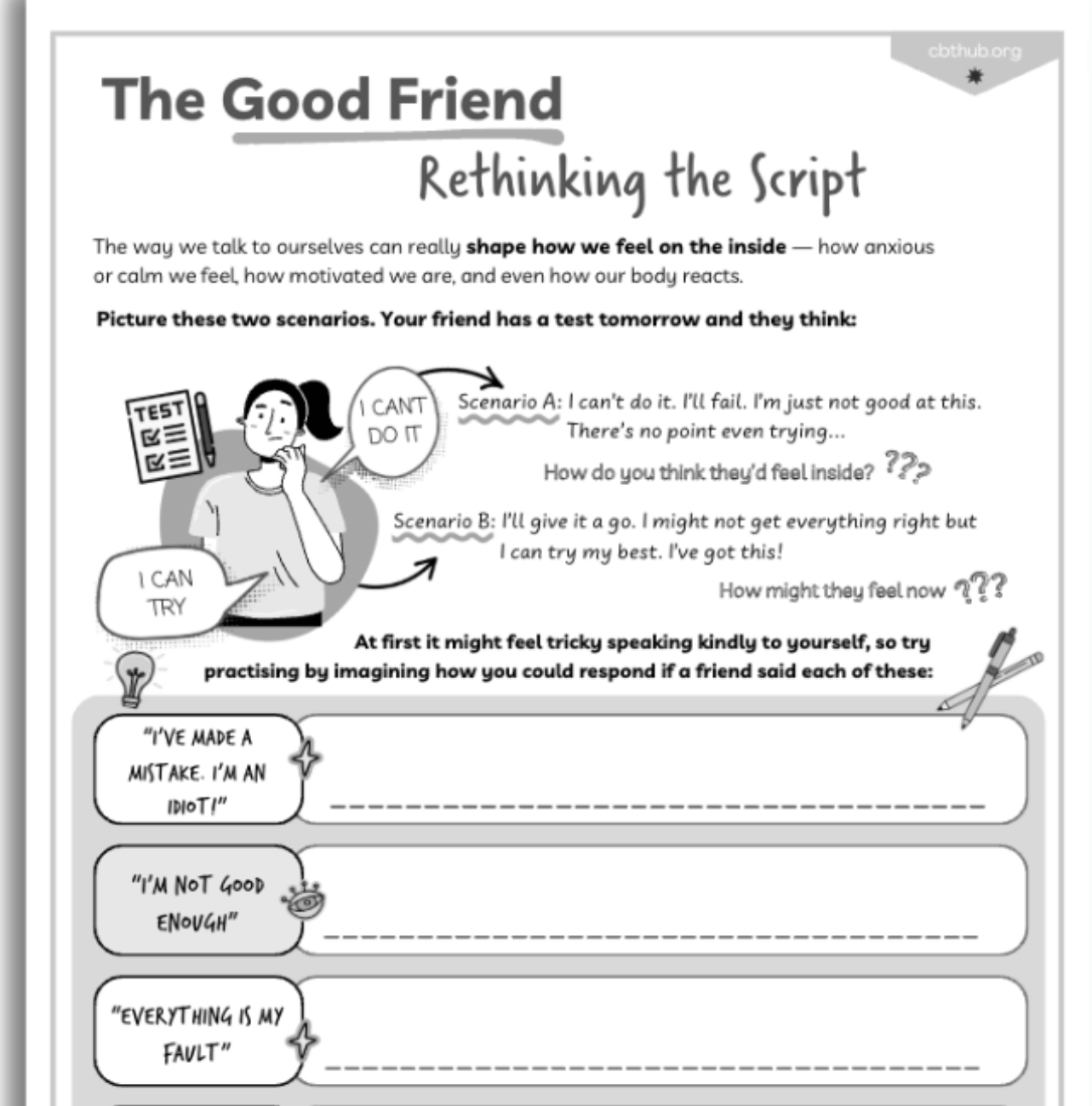
This worksheet helps young people notice unhelpful self-critical thoughts and practise responding with more compassionate, supportive alternatives. Using everyday scenarios, it invites young people to compare how harsh self-talk affects feelings and motivation, and to explore how speaking to themselves as they would a good friend can shift their emotional experience.
It supports the development of self-compassion, balanced thinking, and emotional regulation, making it a useful tool for work around self-esteem, anxiety, and low mood.

References and Further Reading
- Fennell, M. (1999). Overcoming Low Self-Esteem: A self-help guide using cognitive behavioural techniques. London: Constable & Robinson.
- Haney, P., & Durlak, J. A. (1998). Changing self-esteem in children and adolescents: A meta-analytic review. Journal of Clinical Child Psychology, 27(4), 423–433. https://doi.org/10.1207/s15374424jccp2704_6.
- Pepping, C. A., O’Donovan, A., & Davis, P. J. (2013). The positive effects of mindfulness on self-esteem. The Journal of Positive Psychology, 8(5), 376–386. https://doi.org/10.1080/17439760.2013.807353.
- Cohen, J. S., Edmunds, J. M., Brodman, D. M., Benjamin, C. L., & Kendall, P. C. (2012). Using self-monitoring: Implementation of collaborative empiricism in cognitive-behavioural therapy. Cognitive and Behavioral Practice, 19(4), 497–507.