


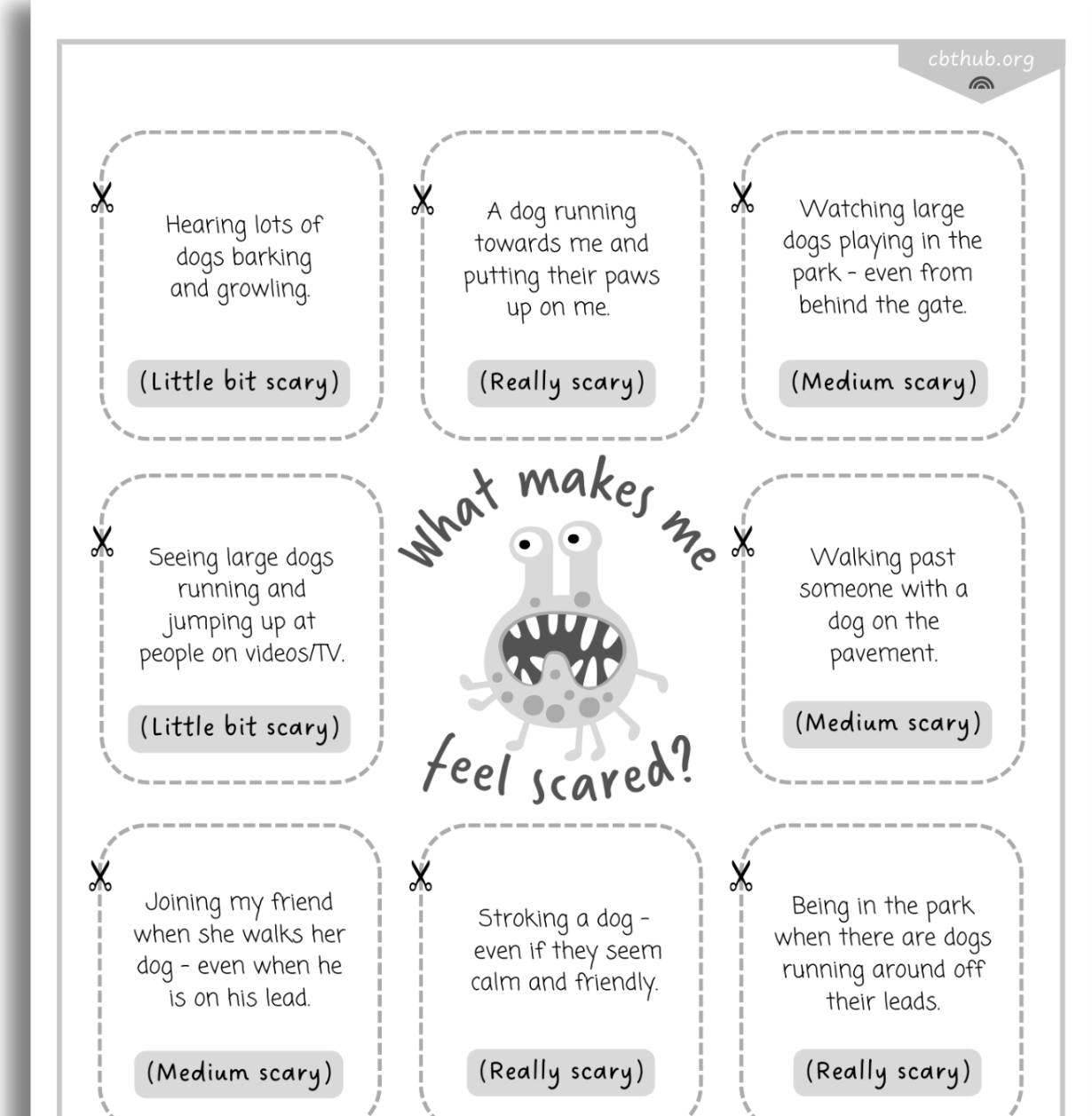
What makes me scared? (example)
This resource is an alternative to the traditional “Exposure Ladder.” It encourages children to actively engage by listing scenarios related to their fear, and then cutting and sorting these according to anxiety level.
These scenarios can then be stuck onto the “My Bravery Journey” worksheet, providing a step by step guide for their exposure journey. This example version uses a character with a fear of dogs.

References and Further Reading
- May, A. C., Rudy, B. M., & Matson, J. L. (2013). Evidence-based behavioral treatment of dog phobia with young children: Two case examples. Behavior Modification, 37(1), 63–79. https://doi.org/10.1177/0145445512458524.
- Fraire, M. G., Halldorsdottir, T., & Ollendick, T. H. (2017). Evidence-based interventions for specific phobias in children and adolescents. Handbook of evidence-based interventions for children and adolescents, 267-278.
- Davis, T. E., Ollendick, T. H., & Öst, L.-G. (2019). One-session treatment of specific phobias in children: Recent developments and a systematic review. Annual Review of Clinical Psychology, 15, 233–256. https://doi.org/10.1146/annurev-clinpsy-050718-095608.
- Flatt, N., & King, N. (2008). Building the Case for Brief Psychointerventions in the Treatment of Specific Phobias in Children and Adolescents. Behaviour Change, 25(4), 191–200. doi:10.1375/bech.25.4.191.
- Foa, E. B., & Kozak, M. J. (1986). Emotional processing of fear: Exposure to corrective information. Psychological Bulletin, 99(1), 20–35. https://doi.org/10.1037/0033-2909.99.1.20.
- Tolin, D. F. (2012). Face your fears: A proven plan to beat anxiety, panic, phobias, and obsessions. John Wiley & Sons.