


Self-Harm Formulation (Example)
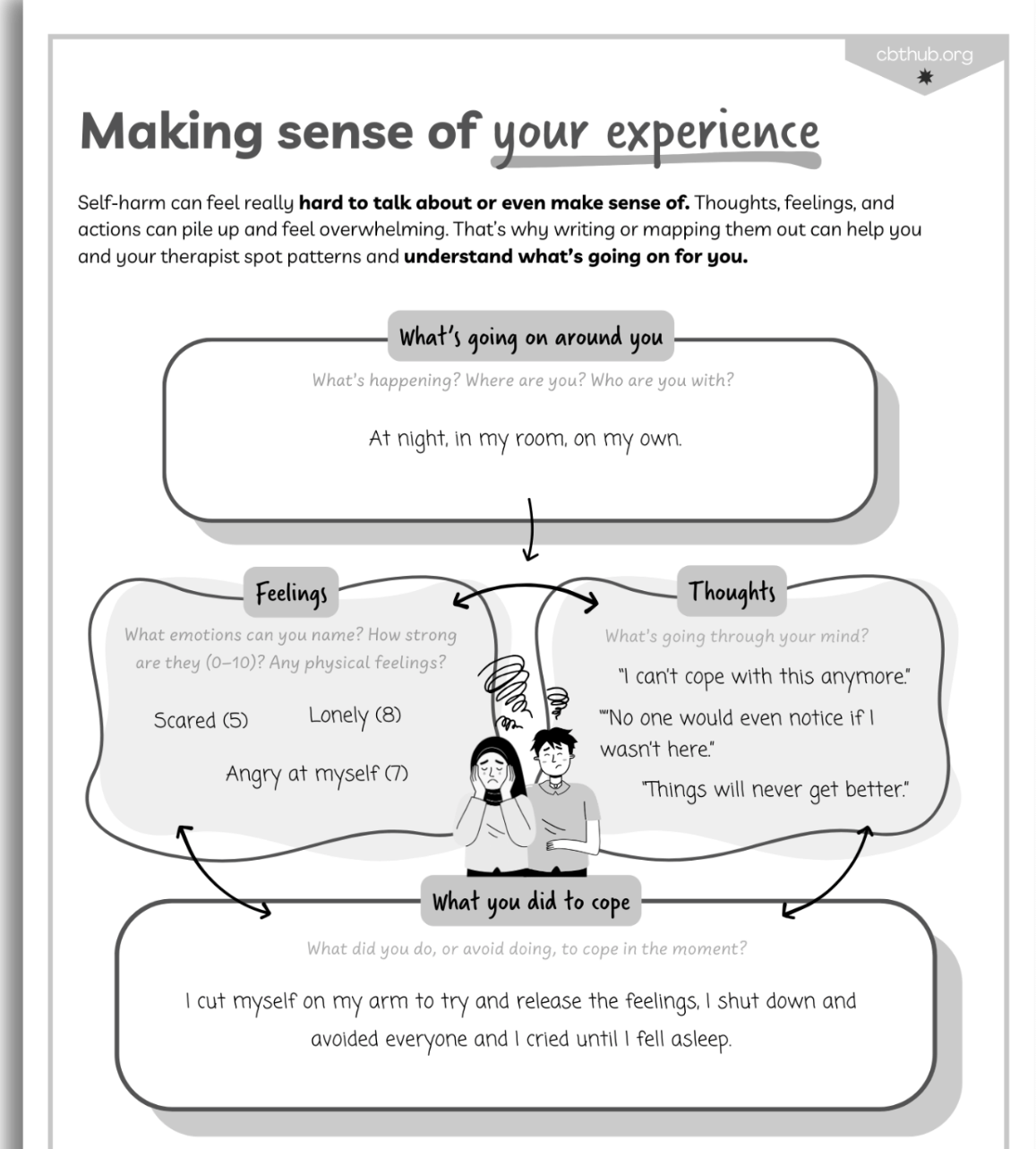
This resource provides a structured framework for formulation, enabling young people to map out the links between their thoughts, feelings, behaviours, and contextual factors in moments of distress. It is designed to support therapists in collaboratively developing an initial formulation around self-harm, highlighting maintaining cycles and coping strategies.
The worksheet can be used by therapists to enhance self-awareness, identify triggers, and open space for exploring alternative ways of managing difficult emotions.

References & Further Reading
- Slee, N., Garnefski, N., van der Leeden, R., Arensman, E., & Spinhoven, P. (2018). Cognitive‐behavioural intervention for self‐harm: Randomised controlled trial. The British Journal of Psychiatry, 192(3), 202–211. https://doi.org/10.1192/bjp.bp.107.037564
- Hawton, K., Witt, K. G., Taylor Salisbury, T. L., Arensman, E., Gunnell, D., Townsend, E., van Heeringen, K., & Hazell, P. (2015). Interventions for self‐harm in children and adolescents. Cochrane Database of Systematic Reviews, 2015(12), CD012013. https://doi.org/10.1002/14651858.CD012013
- Labelle, R., Pouliot, L., & Janelle, A. (2015). A systematic review and meta-analysis of cognitive behavioural treatments for suicidal and self-harm behaviours in adolescents. Canadian Psychology / Psychologie canadienne, 56(4), 368–378. https://doi.org/10.1037/a0039159
- Ougrin, D., Tranah, T., Leigh, E., Taylor, L., & Asarnow, J. R. (2012). Practitioner review: Self-harm in adolescents. Journal of Child Psychology and Psychiatry, 53(4), 337–350. https://doi.org/10.1111/j.1469-7610.2012.02525.x
- Wright, B., Hooke, N., Neupert, S., Nyein, C., & Ker, S. (2013). Young people who cut themselves: Can understanding the reasons guide the treatment? Advances in Psychiatric Treatment, 19(6), 446–456. https://doi.org/10.1192/apt.bp.112.011049
- Burns, J., Dudley, M., Hazell, P., & Patton, G. (2005). Clinical management of deliberate self-harm in young people: The need for evidence-based approaches to reduce repetition. Australian and New Zealand Journal of Psychiatry, 39(3), 121–128. https://doi.org/10.1080/j.1440-1614.2005.01511.x
- Oldershaw, A., Simic, M., Grima, E., Jollant, F., Richards, C., Taylor, L., & Schmidt, U. (2012). The effect of cognitive behavior therapy on decision making in adolescents who self-harm: A pilot study. Suicide and Life-Threatening Behavior, 42(3), 255–265. https://doi.org/10.1111/j.1943-278X.2012.0087.x
- Kabat, K., & Mazelis, R. (2002). Cutting down: A CBT workbook for treating young people who self-harm. Jessica Kingsley Publishers.