


Self-Harm Functional Analysis
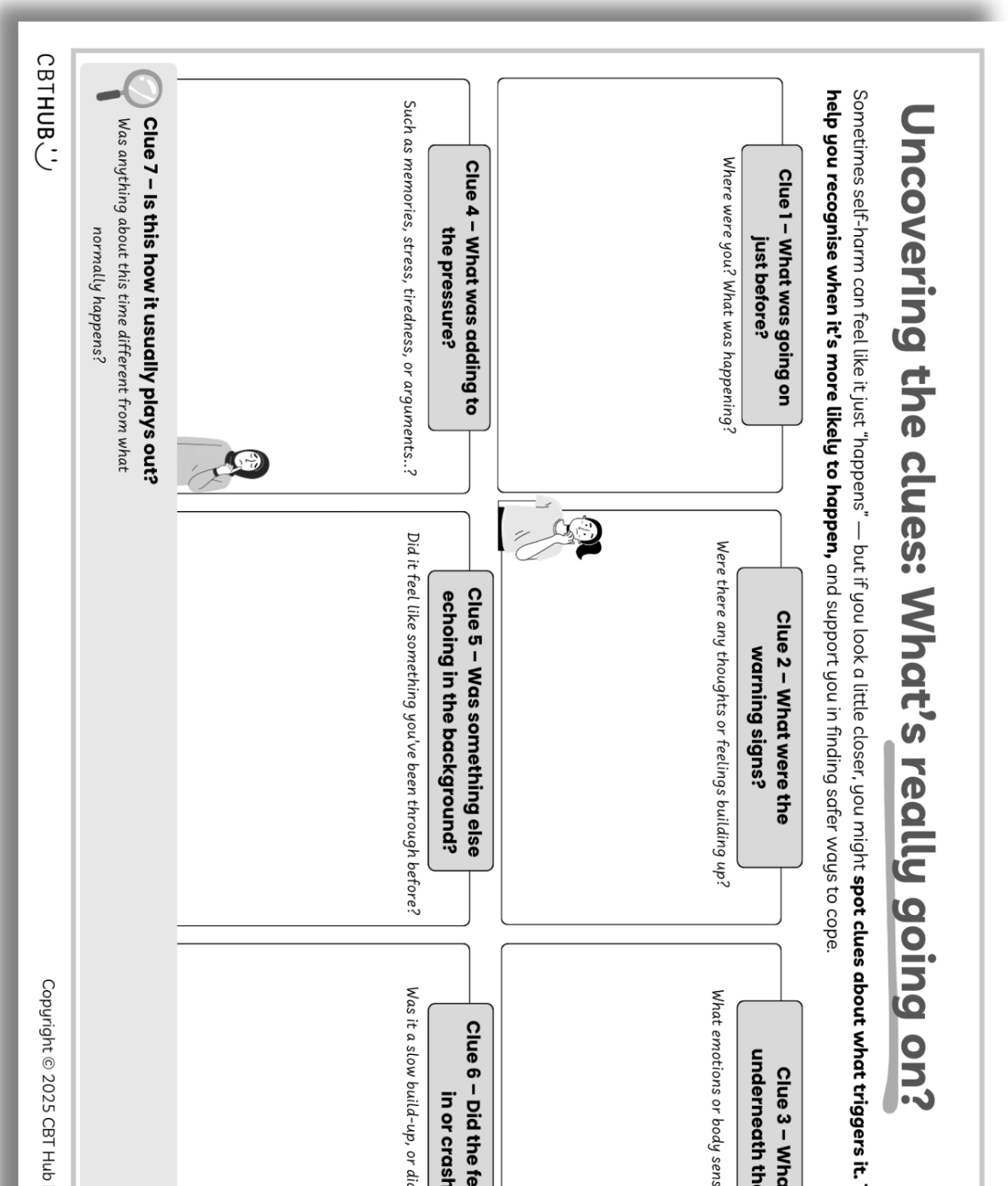
This formulation-based resource is designed to help young people and therapists identify the triggers and maintaining factors surrounding self-harm. By breaking down the sequence into “clues” — such as warning signs, underlying emotions, pressures, and familiar patterns — the worksheet supports the development of a shared formulation and increases awareness of vulnerability factors.
It can be used in-session or as a reflective task between sessions, helping young people recognise when self-harm is more likely to occur and explore safer coping strategies.

References & Further Reading
- Slee, N., Garnefski, N., van der Leeden, R., Arensman, E., & Spinhoven, P. (2018). Cognitive‐behavioural intervention for self‐harm: Randomised controlled trial. The British Journal of Psychiatry, 192(3), 202–211. https://doi.org/10.1192/bjp.bp.107.037564
- Hawton, K., Witt, K. G., Taylor Salisbury, T. L., Arensman, E., Gunnell, D., Townsend, E., van Heeringen, K., & Hazell, P. (2015). Interventions for self‐harm in children and adolescents. Cochrane Database of Systematic Reviews, 2015(12), CD012013. https://doi.org/10.1002/14651858.CD012013
- Labelle, R., Pouliot, L., & Janelle, A. (2015). A systematic review and meta-analysis of cognitive behavioural treatments for suicidal and self-harm behaviours in adolescents. Canadian Psychology / Psychologie canadienne, 56(4), 368–378. https://doi.org/10.1037/a0039159
- Ougrin, D., Tranah, T., Leigh, E., Taylor, L., & Asarnow, J. R. (2012). Practitioner review: Self-harm in adolescents. Journal of Child Psychology and Psychiatry, 53(4), 337–350. https://doi.org/10.1111/j.1469-7610.2012.02525.x
- Wright, B., Hooke, N., Neupert, S., Nyein, C., & Ker, S. (2013). Young people who cut themselves: Can understanding the reasons guide the treatment? Advances in Psychiatric Treatment, 19(6), 446–456. https://doi.org/10.1192/apt.bp.112.011049
- Burns, J., Dudley, M., Hazell, P., & Patton, G. (2005). Clinical management of deliberate self-harm in young people: The need for evidence-based approaches to reduce repetition. Australian and New Zealand Journal of Psychiatry, 39(3), 121–128. https://doi.org/10.1080/j.1440-1614.2005.01511.x
- Oldershaw, A., Simic, M., Grima, E., Jollant, F., Richards, C., Taylor, L., & Schmidt, U. (2012). The effect of cognitive behavior therapy on decision making in adolescents who self-harm: A pilot study. Suicide and Life-Threatening Behavior, 42(3), 255–265. https://doi.org/10.1111/j.1943-278X.2012.0087.x
- Kabat, K., & Mazelis, R. (2002). Cutting down: A CBT workbook for treating young people who self-harm. Jessica Kingsley Publishers.