


Examining Panic-Related Thoughts
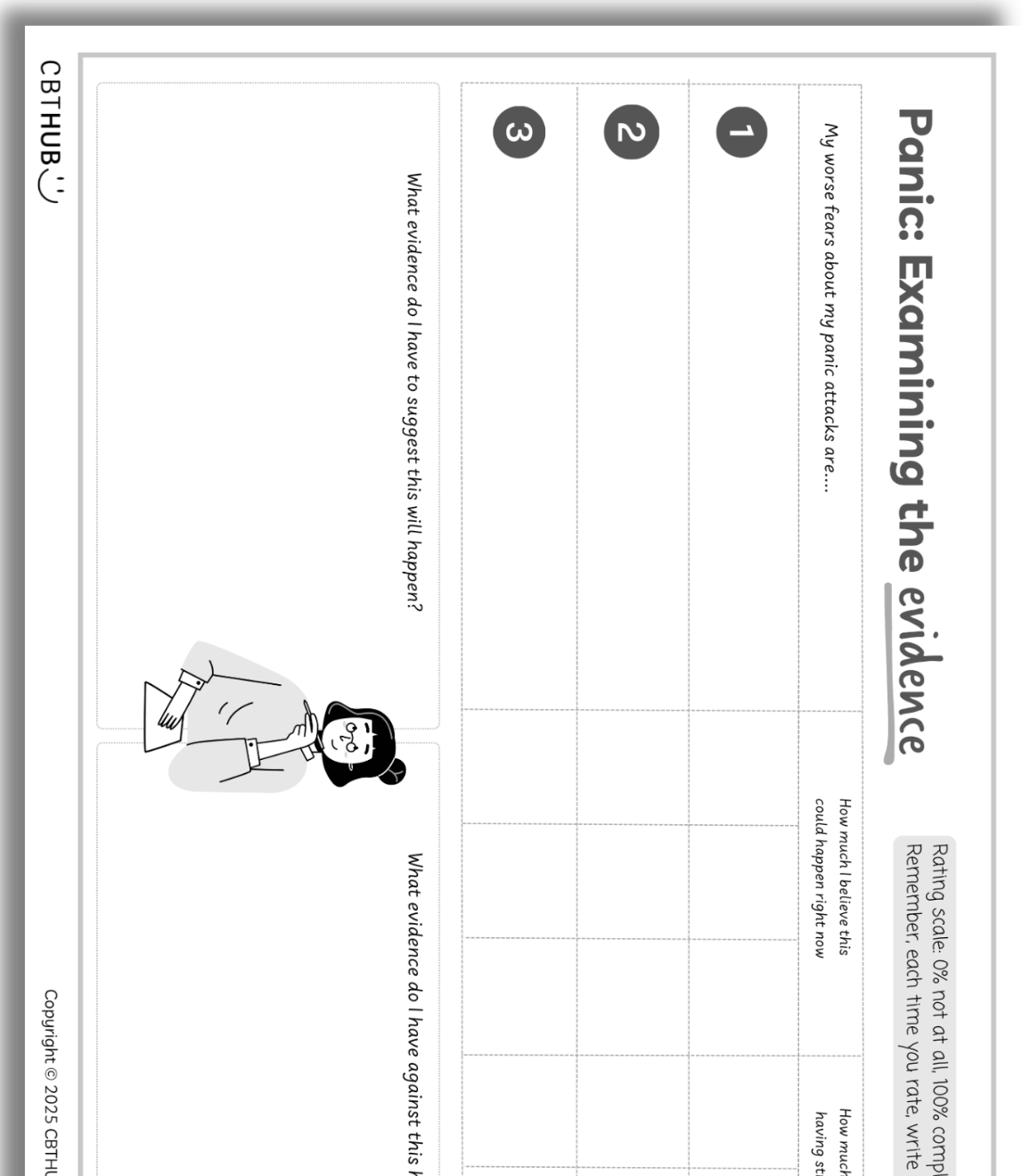
This resource guides young people through the process of identifying their core fears around panic attacks and evaluating the evidence for and against these beliefs. It introduces a structured way to reflect on how beliefs shift depending on context, using ratings and cognitive evidence-building.
It is designed to support therapists in delivering cognitive restructuring work for panic, helping young people examine unhelpful thoughts and build more balanced, flexible beliefs through guided discussion and reflection.

References and Further Reading
- American Psychiatric Association. Diagnostic and statistical manual of mental disorders, 5th edn Arlington, Virginia: American Psychiatric Association, 2013.
- Baker, H. and Waite, P. (2020) The identification and psychological treatment of panic disorder in adolescents: a survey of CAMHS clinicians. Child and Adolescent Mental Health, 25 (3). pp. 135-142
- Barlow, D.H., Raffa, S.D. and Cohen, E.M., 2002. Psychosocial treatments for panic disorders, phobias, and generalized anxiety disorder. A guide to treatments that work, 2, pp.301-336.
- Clark, D.M., Salkovskis, P.M., Hackmann, A., Wells, A., Ludgate, J. and Gelder, M., 1999. Brief cognitive therapy for panic disorder: a randomized controlled trial. Journal of Consulting and Clinical Psychology, 67(4), p.583.
- Craske, M. G., & Barlow, D. H. (2001). Panic disorder and agoraphobia. In D. H. Barlow (Ed.), Clinical handbook of psychological disorders: A step-by-step treatment manual(3rd ed., pp. 1–59). The Guilford Press.