


Unhelpful Thinking Styles Recall Activity
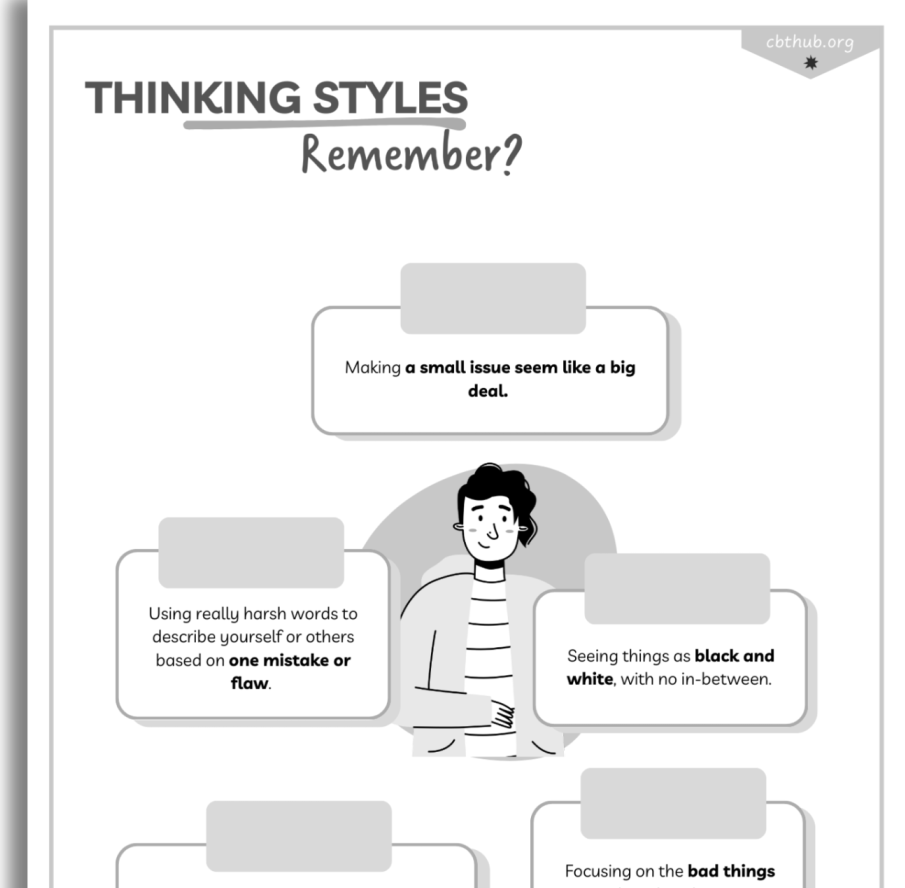
This worksheet focuses on common thinking biases, with blank spaces for young people to fill in after receiving psychoeducation.
It is designed to be assigned as homework or used during sessions as a practical exercise to promote young people’s active engagement.

References and further Reading
- Craske, M. G., & Pontillo, D. C. (2005). Cognitive biases in anxiety disorders and their effect on cognitive-behavioral treatment. Bulletin of the Menninger Clinic, 65(1), 58–79.
- Sportel, B. E., de Hullu, E., de Jong, P. J., & Nauta, M. H. (2013). Cognitive bias modification versus CBT in reducing adolescent social anxiety: A randomized controlled trial. 8(5), e64355.
- Stallard, P. (2002). Think Good – Feel Good: A cognitive behaviour therapy workbook for children and young people. Chichester: John Wiley & Sons.
- Oxford Guide to Brief and Low Intensity Interventions for Children and Young People (Oxford Guides to Cognitive Behavioural Therapy). (2022, July 18). Paperback.
- Beck, A. T., & Beck, J. S. (1995). Cognitive therapy: Basics and beyond. New York: Guilford.
- Beck, A. T., Rush, A. J., Shaw, B. F., & Emery, G. (1979). Cognitive therapy of depression. New York: Guilford.