


Five Ways to Wellbeing Activity Template
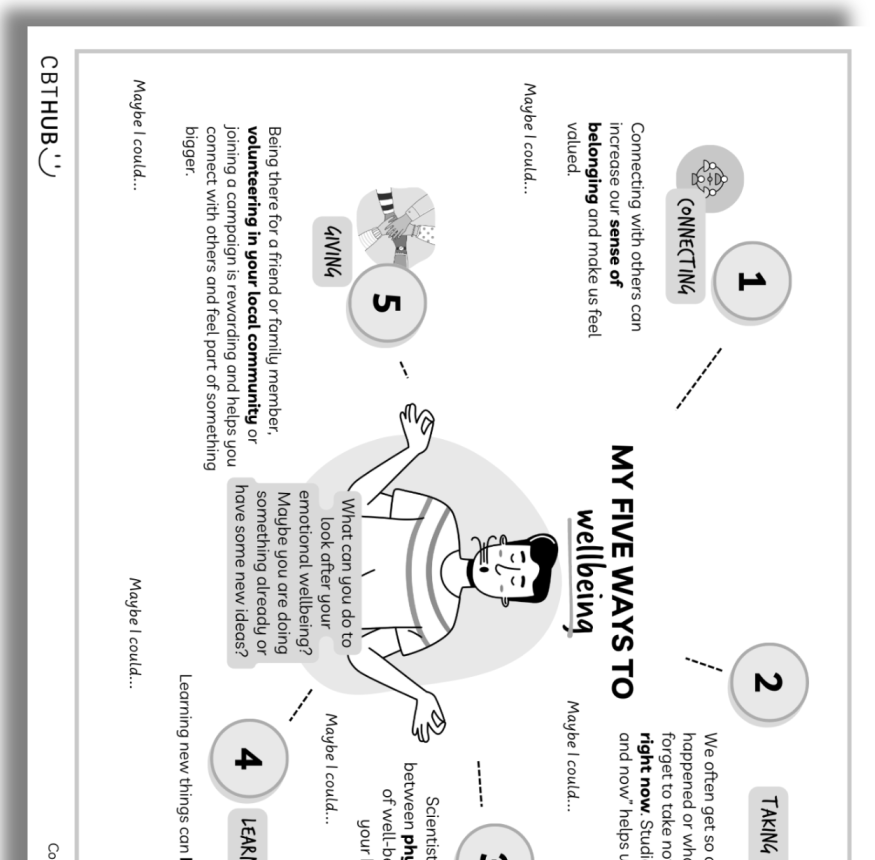
This worksheet encourages young people to develop their own ideas for incorporating the “Five Ways to Wellbeing” practices into their daily lives, helping to enhance their mental health and overall happiness.

References and Further Reading
- Brugha, T. S., Weich, S., Singleton, N., Lewis, G., Bebbington, P. E., Jenkins, R., & Meltzer, H. (2005). Primary group size, social support, gender and future mental health status in a prospective study of people living in private households throughout Great Britain. Psychological Medicine, 35(5), 705–714.
- Dunn, A. L., Trivedi, M. H., Kampert, J. B., Clark, C. G., & Chambliss, H. O. (2002). The DOSE study: A clinical trial to examine efficacy and dose response of exercise as treatment for depression. Controlled Clinical Trials, 23(5), 584–603.
- Dunn, A. L., Trivedi, M. H., Kampert, J. B., Clark, C. G., & Chambliss, H. O. (2005). Exercise treatment for depression: Efficacy and dose response. American Journal of Preventive Medicine, 28(1), 1–8.
- Acevedo, E. O., & Ekkekakis, P. (2006). Psycho-biology of physical activity. Champaign, IL: Human Kinetics.
- Abdallah, S., Steuer, N., Marks, N., & Page, N. (2008). Well-being evaluation tools: A research and development project for the Big Lottery Fund [in press]. London: nef.
- Feinstein, L., Vorhaus, J., & Sabates, R. (2008). Learning through life challenge report. London: Foresight Mental Capital and Wellbeing Project.
- Feinstein, L., & Hammond, C. (2004). The contribution of adult learning to health and social capital. Oxford Review of Education, 30(2), 199–221.
- Hammond, C. (2004). Impacts of lifelong learning upon emotional resilience, psychological and mental health: Fieldwork evidence. Oxford Review of Education, 30(4), 551–568.
- Rilling, J., Glenn, A., Jairam, M., Pagnoni, G., Goldsmith, D., Elfenbein, H., & Lilienfeld, S. (2007). Neural correlates of social cooperation and non-cooperation as a function of psychopathy. Biological Psychiatry, 61(11), 1260–1271.
- Greenfield, E. A., & Marks, N. F. (2004). Formal volunteering as a protective factor for older adults’ psychological well-being. Journals of Gerontology, Series B: Psychological Sciences and Social Sciences, 59B(5), 258–264.
- Harlow, R. E., & Cantor, N. (1996). Still participating after all these years: A study of life task participation in later life. Journal of Personality and Social Psychology, 71(6), 1235–1249.
- Brown, K. W., & Ryan, R. M. (2003). The benefits of being present: Mindfulness and its role in psychological well-being. Journal of Personality and Social Psychology, 84(4), 822–848.
- Ryan, R. M., & Deci, E. L. (2000). Self-determination theory and facilitation of intrinsic motivation, social development, and well-being. American Psychologist, 55(1), 68–78.
- Fredrickson, B. L. (2003). The value of positive emotions: The emerging science of positive psychology is coming to understand why it’s good to feel good. American Scientist, 91(4), 330–335.