


Monitoring and Categorising Worries (Worry Diary)
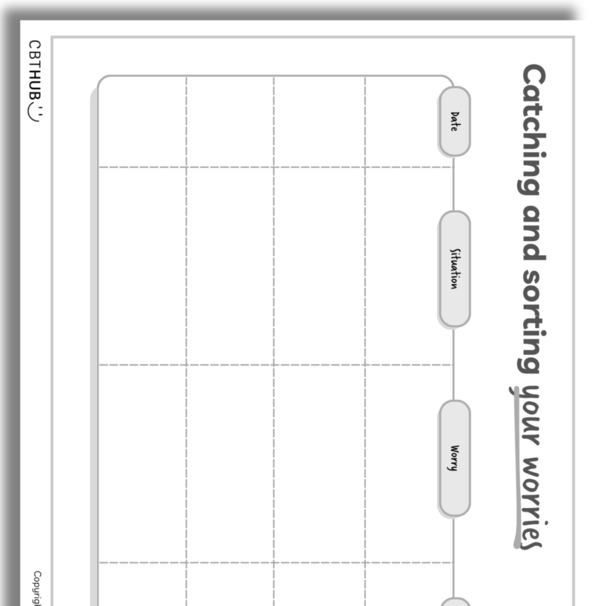
This worksheet assists young people to record their worries, and to note the context in which they occur. Additionally, it has a column to record whether worries are practical or hypothetical.
Self-monitoring is a crucial skill in CBT, enhancing patient awareness of cognitive, emotional, and behavioural patterns and their connections. It also helps identify unhelpful thoughts and behaviours (e.g. Cohen et al., 2013).

References and Further Reading
- Proudfoot, J., & Nicholas, J. (2010). Monitoring and evaluation in low intensity CBT interventions. Oxford guide to low intensity CBT interventions, 97-104.
- Craske, M. G., & Tsao, J. C. I. (1999). Self-monitoring with panic and anxiety disorders. Psychological Assessment, 11(4), 466–479. https://doi.org/10.1037/1040-3590.11.4.466.
- Cohen, J.S., Edmunds, J.M., Brodman, D.M., Benjamin, C.L., Kendall, P.C. (2013). Using self-monitoring: implementation of collaborative empiricism in cognitive-behavioral therapy. Cognitive and Behavioral Practice, 20(4), 419-428.