


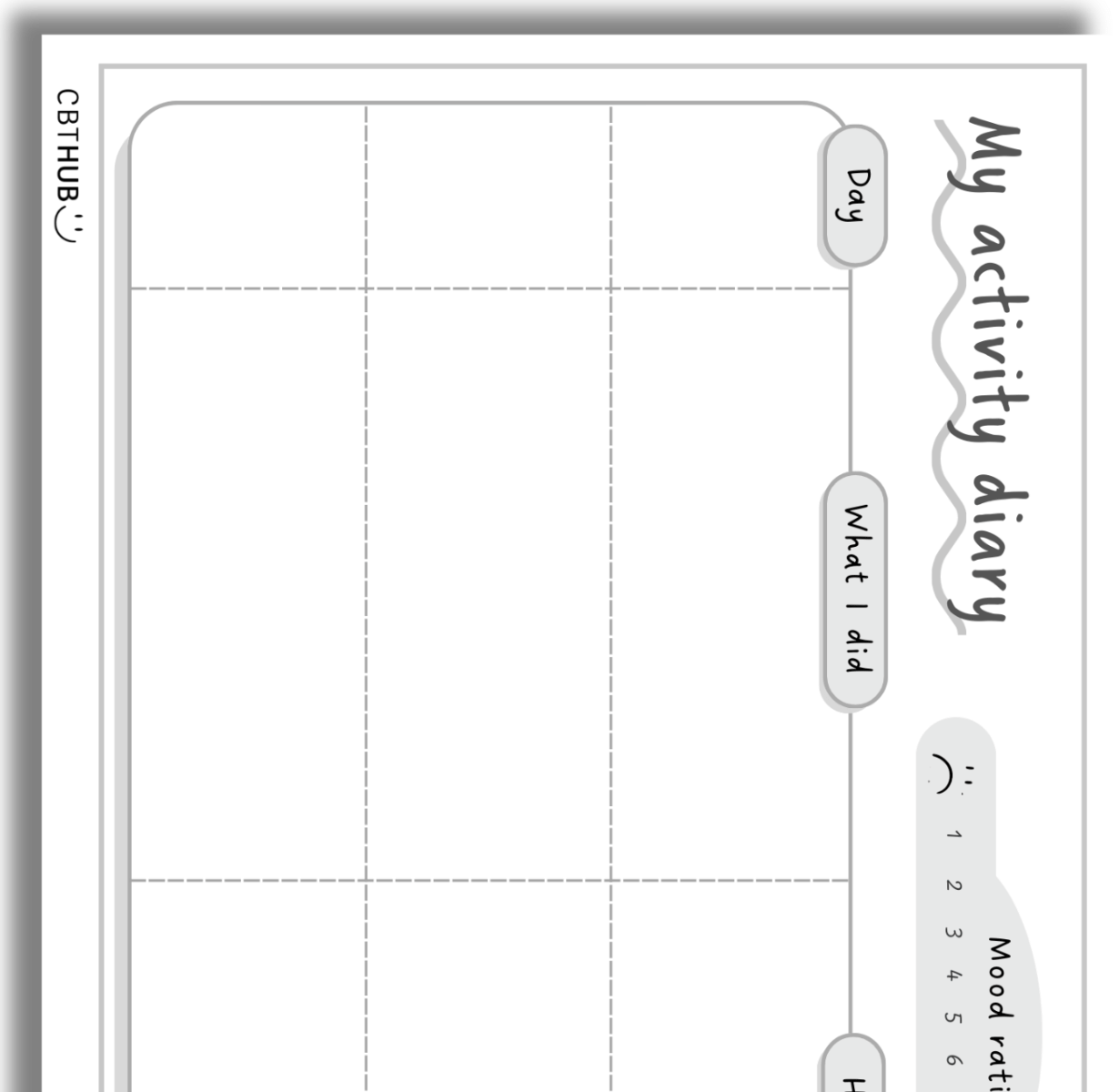
My activity diary
This self-monitoring tool is designed to help children track their daily activities and mood across the week.
By consistently logging activities and associated mood ratings, users can gain insight into patterns and triggers, empowering them to better understand their emotional well-being and identify strategies that support positive changes.

References and Further Reading
- Loades, M. E., & Myles-Hooton, P. (Eds.). (2020). Oxford guide to brief and low intensity interventions for children and young people. Oxford University Press.
- Arnberg, A., & Öst, L.-G. (2014). CBT for children with depressive symptoms: A meta-analysis. Cognitive Behaviour Therapy, 43(4), 275–288.
- Oud, M., de Winter, L., Vermeulen-Smit, E., Bodden, D., Nauta, M., Stone, L., van den Heuvel, M., Al Taher, R., de Graaf, I., Kendall, T., Engels, R., & Stikkelbroek, Y. (2019). Effectiveness of CBT for children and adolescents with depression: A systematic review and meta-regression analysis. Psychological Medicine.
- Loades, M. E., & Myles-Hooton, P. (Eds.). (2020). Oxford guide to brief and low intensity interventions for children and young people. Oxford University Press.
- Proudfoot, J., & Nicholas, J. (2010). Monitoring and evaluation in low intensity CBT interventions. In Oxford guide to low intensity CBT interventions (pp. 97-104).
- Cohen, J. S., Edmunds, J. M., Brodman, D. M., Benjamin, C. L., & Kendall, P. C. (2013). Using self-monitoring: Implementation of collaborative empiricism in cognitive-behavioural therapy. Cognitive and Behavioural Practice, 20(4), 419–428.