


Understanding Breathing and Emotional Regulation
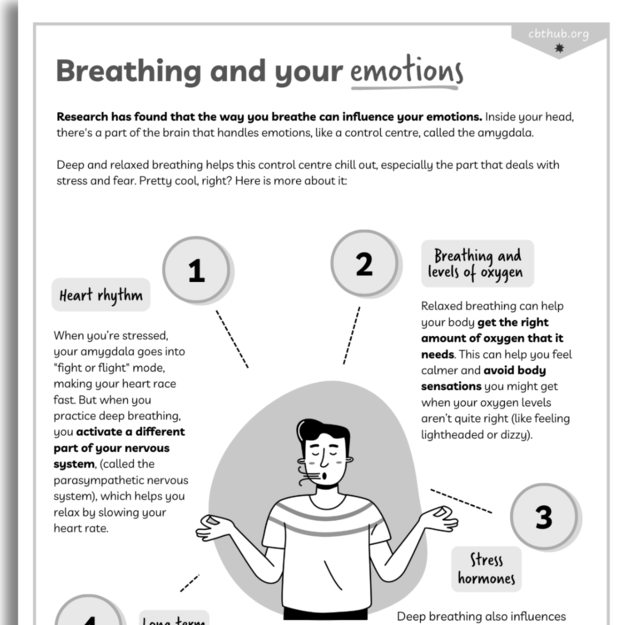
This worksheet is designed to help practitioners motivate young people to engage with breathing exercises, encouraging them to use these techniques to manage stress and regulate their emotions.
It details how deep, relaxed breathing activates the parasympathetic nervous system, which helps slow the heart rate and reduce cortisol. By practising deep breathing, individuals can increase oxygen levels in the body, reduce feelings of dizziness, and build long-term resilience against stress.

References and Further Reading
- Fredrickson, B. L. (2003). The value of positive emotions: The emerging science of positive psychology is coming to understand why it’s good to feel good. American Scientist, 91(4), 330–335.
- Fincham, G. W., Strauss, C., Montero-Marin, J., et al. (2023). Effect of breathwork on stress and mental health: A meta-analysis of randomised-controlled trials. Scientific Reports, 13, 432. https://doi.org/10.1038/s41598-022-27247-y.
- Zhou, X., et al. (2020). Effects of mindfulness-based stress reduction on anxiety symptoms in young people: A systematic review and meta-analysis. Psychiatry Research, 289, 113002. https://doi.org/10.1016/j.psychres.2020.113002.
- Dunning, D. L., Griffiths, K., Kuyken, W., Crane, C., Foulkes, L., Parker, J., & Dalgleish, T. (2019). Research review: The effects of mindfulness-based interventions on cognition and mental health in children and adolescents—A meta-analysis of randomized controlled trials. Journal of Child Psychology and Psychiatry, 60(3), 244–258. https://doi.org/10.1111/jcpp.12980.
- Lin, J., Chadi, N., & Shrier, L. (2019). Mindfulness-based interventions for adolescent health. Current Opinion in Pediatrics, 31(4), 469-475. https://doi.org/10.1097/MOP.0000000000000770.