


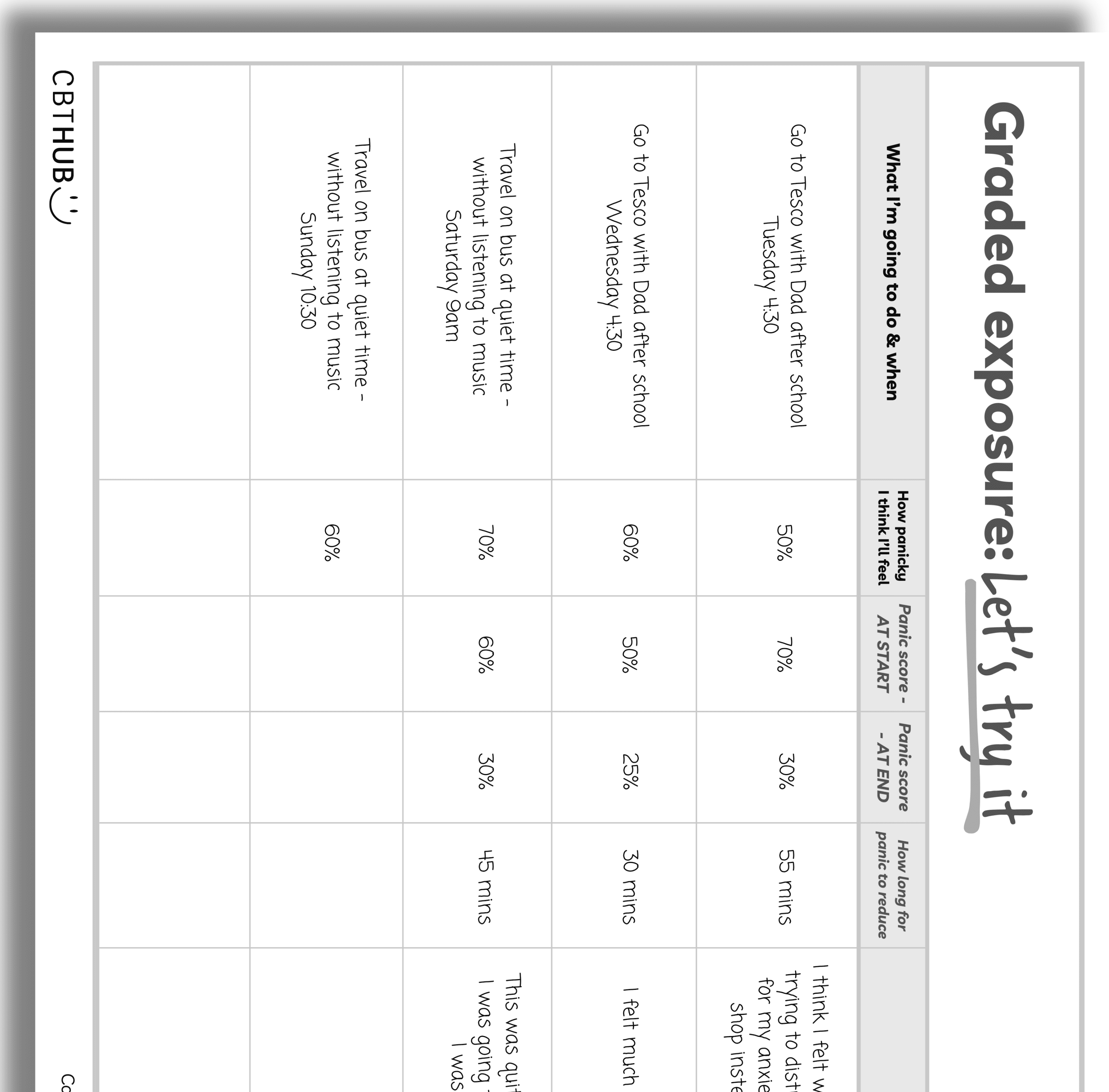
Graded exposure log (example)
This resource can be used by young people to track their exposure activities completed outside of sessions, and can also be used in session to guide discussions around progress.
The example version provides a log filled in by Shaan, a young person experiencing panic attacks in crowded places.

References and Further Reading
- Pincus, D. B., Ehrenreich-May, J., Whitton, S. W., Mattis, S. G., & Barlow, D. H. (2010). Cognitive-behavioral treatment of panic disorder in adolescence. Journal of Clinical Child & Adolescent Psychology, 39(5), 638–649 https://doi.org/10.1080/15374416.2010.501288.
- Peterman, J. S., Carper, M. M., & Kendall, P. C. (2016). Testing the Habituation-Based Model of Exposures for Child and Adolescent Anxiety. Journal of Clinical Child and Adolescent Psychology, pp. 1–11 https://doi.org/10.1080/15374416.2016.1163707.
- Hoffman , E. C. , & Mattis , S. G. ( 2000 ). A developmental adaptation of panic control treatment for panic disorder in adolescence . Cognitive and Behavioral Practice, 7 , 253 – 261.
- Micco , J. A. , Choate-Summers , M. L. , Ehrenreich , J. T. , Pincus , D. B. , & Mattis , S. G. ( 2007 ). Identifying efficacious treatment components of Panic Control Treatment for Adolescents: A preliminary investigation . Child & Family Behavior Therapy , 29 ( 4 ), 1 – 23.
- Proudfoot, J., & Nicholas, J. (2010). Monitoring and evaluation in low intensity CBT interventions. Oxford guide to low intensity CBT interventions, 97-104.
- Craske, M. G., & Tsao, J. C. I. (1999). Self-monitoring with panic and anxiety disorders. Psychological Assessment, 11(4), 466–479. https://doi.org/10.1037/1040-3590.11.4.466