


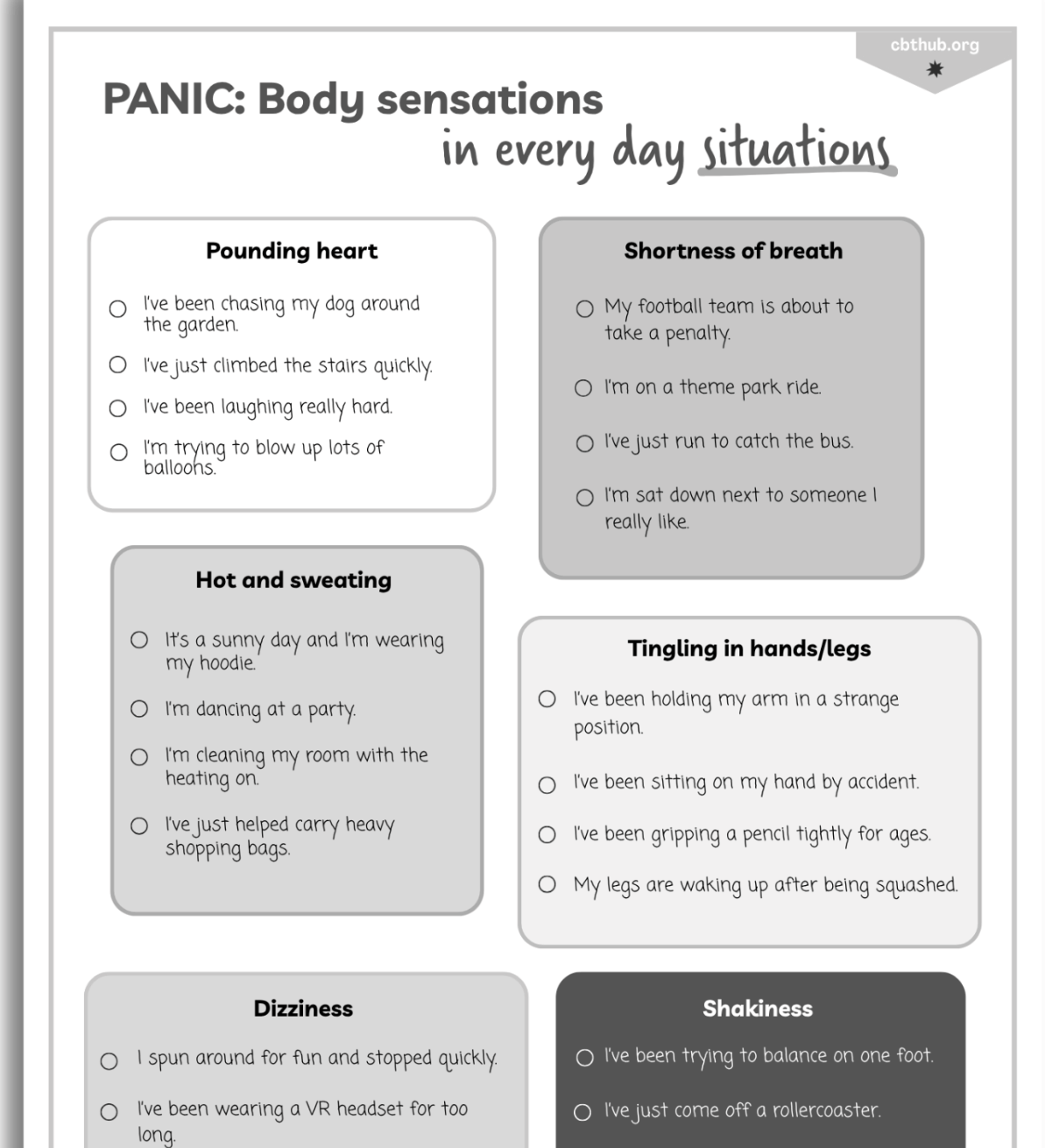
Body Sensations in Everyday Life
(Companion to “Same body signs, different meanings”)
This psychoeducational menu is designed to support young people in reappraising common physical symptoms of panic. It offers a bank of relatable, non-threatening examples of situations where bodily sensations—such as a racing heart, shortness of breath, dizziness, or shakiness—can occur without danger.
It is designed to help therapists challenge misinterpretations of bodily cues by normalising these experiences and providing a reference for alternative, everyday explanations. Used alongside cognitive interventions, the resource encourages cognitive flexibility and supports the development of more balanced interpretations—key in reducing panic maintenance.

References and Further Reading
- American Psychiatric Association. Diagnostic and statistical manual of mental disorders, 5th edn Arlington, Virginia: American Psychiatric Association, 2013.
- Baker, H. and Waite, P. (2020) The identification and psychological treatment of panic disorder in adolescents: a survey of CAMHS clinicians. Child and Adolescent Mental Health, 25 (3). pp. 135-142
- Barlow, D.H., Raffa, S.D. and Cohen, E.M., 2002. Psychosocial treatments for panic disorders, phobias, and generalized anxiety disorder. A guide to treatments that work, 2, pp.301-336.
- Clark, D.M., Salkovskis, P.M., Hackmann, A., Wells, A., Ludgate, J. and Gelder, M., 1999. Brief cognitive therapy for panic disorder: a randomized controlled trial. Journal of Consulting and Clinical Psychology, 67(4), p.583.
- Craske, M. G., & Barlow, D. H. (2001). Panic disorder and agoraphobia. In D. H. Barlow (Ed.), Clinical handbook of psychological disorders: A step-by-step treatment manual(3rd ed., pp. 1–59). The Guilford Press.