


Identifying Panic Triggers (Example)
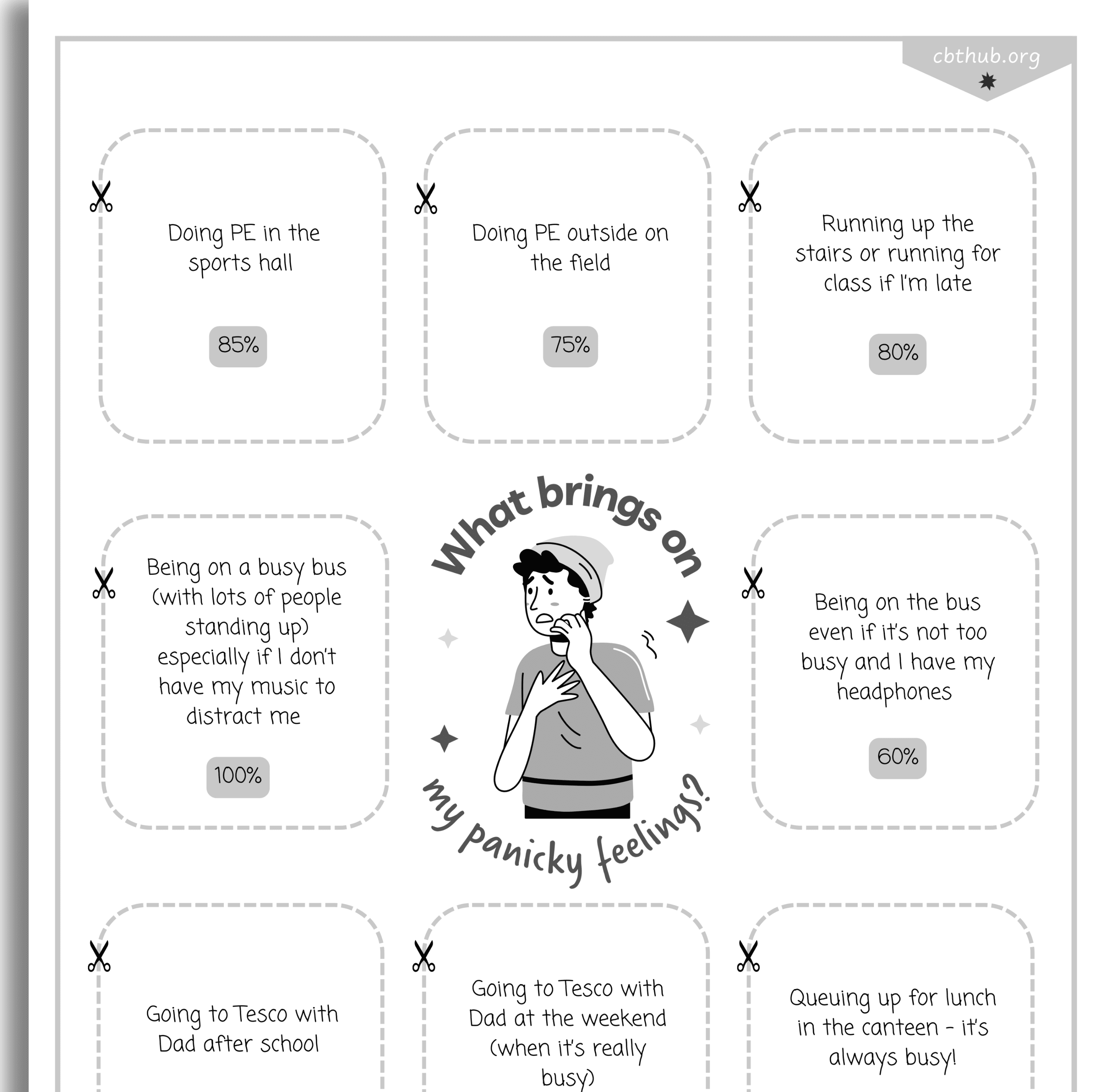
This worksheet supports graded exposure work by helping young people consider a range of situations that evoke varying levels of panic. It is an alternative to the traditional “Exposure Ladder.” This example version uses the case of Shaan who experiences panic attacks in crowded places.
Young people are encouraged to actively engage by cutting and sorting feared situations according to anxiety level. These can then be stuck onto the “Journey to a calmer me” worksheet, providing a step by step guide for their exposure journey.

References and Further Reading
- Pincus, D. B., Ehrenreich-May, J., Whitton, S. W., Mattis, S. G., & Barlow, D. H. (2010). Cognitive-behavioral treatment of panic disorder in adolescence. Journal of Clinical Child & Adolescent Psychology, 39(5), 638–649. https://doi.org/10.1080/15374416.2010.501288.
- Peterman, J. S., Carper, M. M., & Kendall, P. C. (2016). Testing the Habituation-Based Model of Exposures for Child and Adolescent Anxiety. Journal of Clinical Child and Adolescent Psychology, pp. 1–11. https://doi.org/10.1080/15374416.2016.1163707.
- Waite, P. (2022). Protocol for a randomised controlled feasibility study examining the efficacy of brief cognitive therapy for the treatment of panic disorder in adolescents (PANDA). Pilot and Feasibility Studies, 8(1). https://doi.org/10.1186/s40814-022-01009-z.
- Hoffman , E. C. , & Mattis , S. G. ( 2000 ). A developmental adaptation of panic control treatment for panic disorder in adolescence . Cognitive and Behavioral Practice, 7 , 253 – 261.
- Micco , J. A. , Choate-Summers , M. L. , Ehrenreich , J. T. , Pincus , D. B. , & Mattis , S. G. ( 2007 ). Identifying efficacious treatment components of Panic Control Treatment for Adolescents: A preliminary investigation . Child & Family Behavior Therapy , 29 ( 4 ), 1 – 23.