


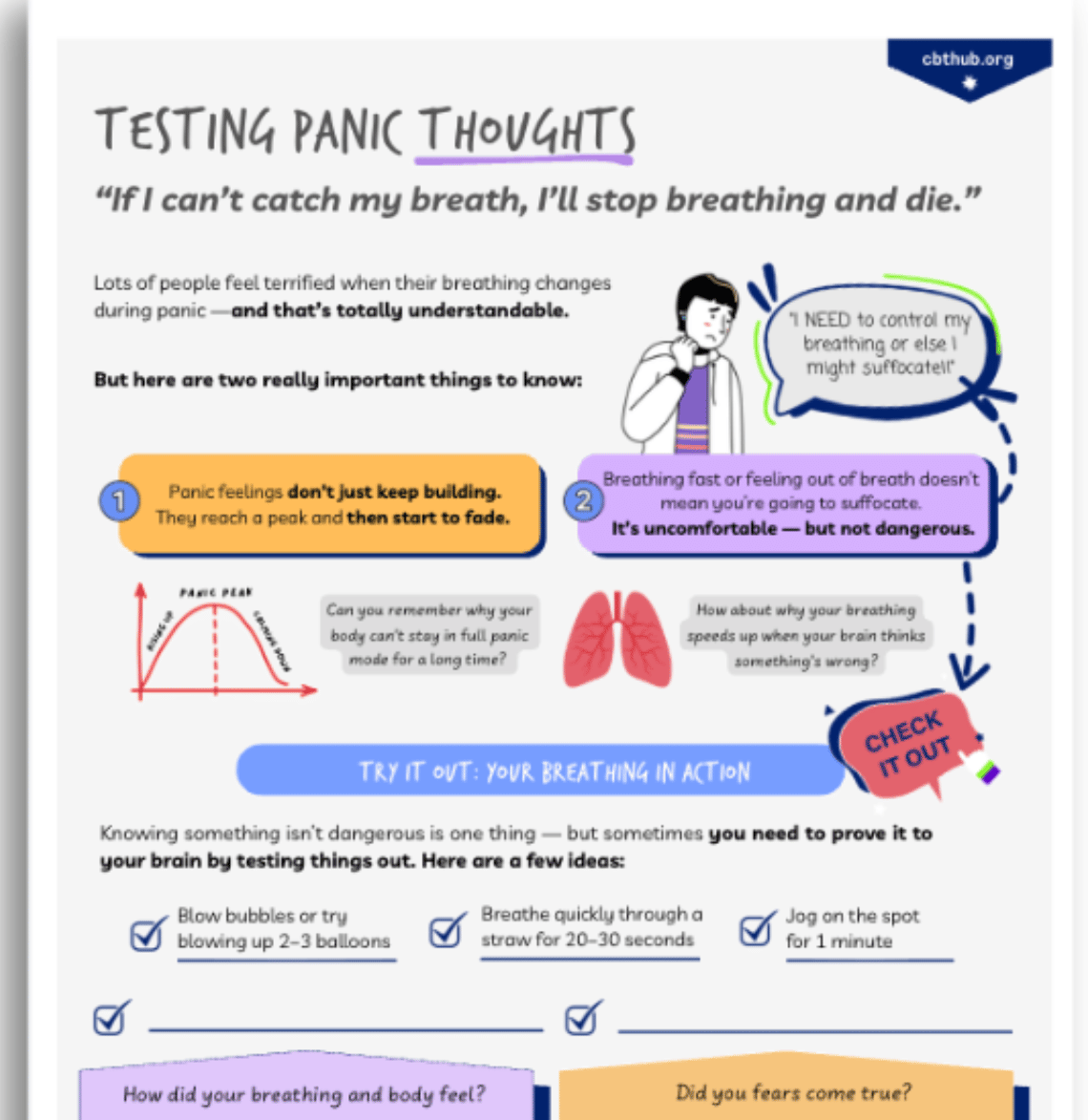
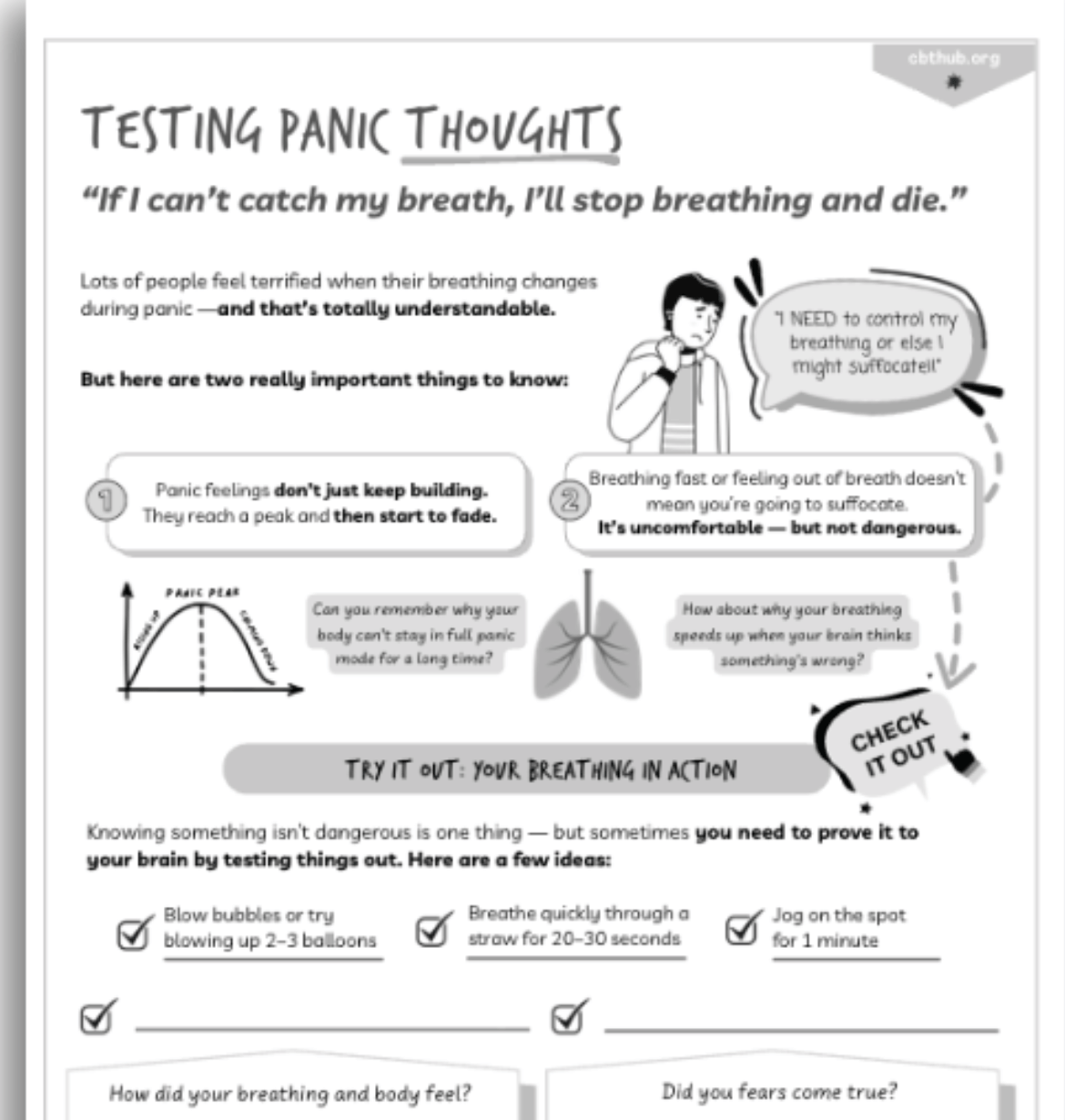
Behavioural Experiment: “What If I Can’t Catch My Breath?”
References and Further Reading
- Birmaher, B., & Ollendick, T. H. (2004). Childhood-onset panic disorder. In T. H. Ollendick, & J. S. March (Eds.), Phobic and anxiety disorders in children and adolescents (pp. 306–333). NewYork:Oxford University Press
- Craske, M. G., & Barlow, D. H. (2001). Panic disorder and agoraphobia. In D. H. Barlow (Ed.), Clinical handbook of psychological disorders: A step-by-step treatment manual (3rd ed., pp. 1–59). The Guilford Press.
- Craske, M.G. and Barlow, D.H., 2022. Mastery of your anxiety and panic: Therapist guide. Oxford University Press.
- Merikangas, K. R., He, J. P., Burstein, M., Swanson, S. A., Avenevoli, S., Cui, L., & Swendsen, J. (2010). Lifetime prevalence of mental disorders in US adolescents: results from the National Comorbidity Survey Replication-Adolescent © 2020 The Authors. Child and Adolescent Mental Health published by John Wiley & Sons Ltd on behalf of Association for Child and Adolescent Mental Health.8 Holly J. Baker & Polly Waite Supplement (NCS-A). Journal of the American Academy of Child &AdolescentPsychiatry, 49, 980–989.
- National Institute for Health and Care Excellence (NICE) (2014) Anxiety Disorders (Online) Available at: www.nice.org.uk/guidance/qs53.
- Richards, J.C., Richardson, V. and Pier, C., 2002. The relative contributions of negative cognitions and self-efficacy to severity of panic attacks in panic disorder. Behaviour Change, 19(2), pp.102-111.
- Vizard, T., Pearce, N., & Davis, J. (2018). Mental Health of Children and Young People in England, 2017. Leeds: Health and Social Care Information Centre.
- Waite, P. Protocol for a randomised controlled feasibility study examining the efficacy of brief cognitive therapy for the treatment of panic disorder in adolescents (PANDA). Pilot Feasibility Stud 8, 49 (2022). https://doi.org/10.1186/s40814-022-01009-z.