


Recognising Panic Thinking Styles
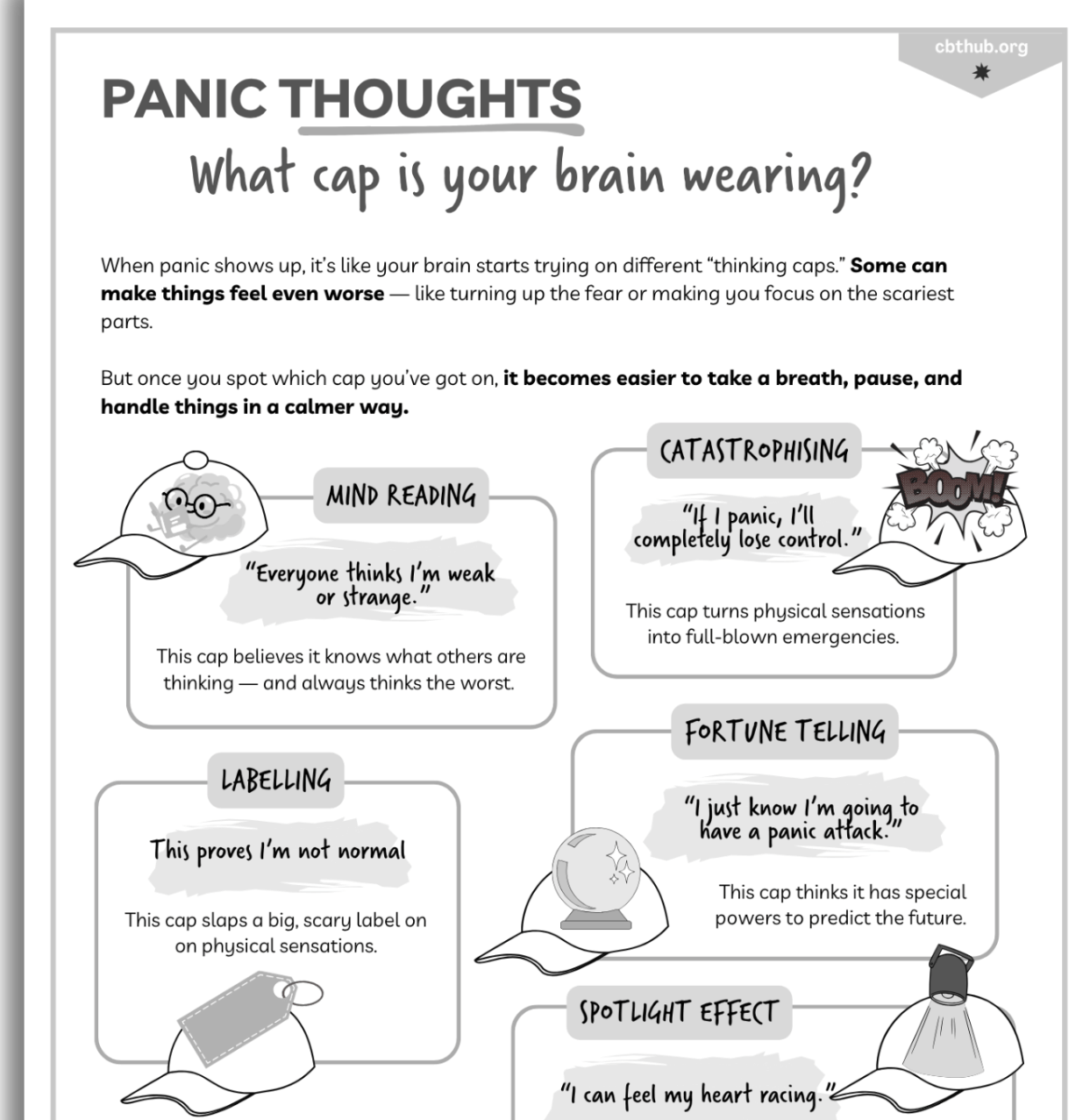
This resource uses a creative ‘thinking cap’ metaphor to help young people recognise common cognitive biases that can drive panic—such as catastrophising, mind reading, and fortune telling. Each “cap” represents a biased thinking style that can make fear feel more intense and harder to manage.
It is designed to support therapists in building metacognitive awareness, helping young people identify unhelpful thinking patterns and respond to panic with more clarity, calm, and control.

References and Further Reading
- Birmaher, B., & Ollendick, T. H. (2004). Childhood-onset panic disorder. In T. H. Ollendick, & J. S. March (Eds.), Phobic and anxiety disorders in children and adolescents (pp. 306–333). NewYork:Oxford University Press
- Craske, M. G., & Barlow, D. H. (2001). Panic disorder and agoraphobia. In D. H. Barlow (Ed.), Clinical handbook of psychological disorders: A step-by-step treatment manual (3rd ed., pp. 1–59). The Guilford Press.
- Craske, M.G. and Barlow, D.H., 2022. Mastery of your anxiety and panic: Therapist guide. Oxford University Press.
- Merikangas, K. R., He, J. P., Burstein, M., Swanson, S. A., Avenevoli, S., Cui, L., & Swendsen, J. (2010). Lifetime prevalence of mental disorders in US adolescents: results from the National Comorbidity Survey Replication-Adolescent © 2020 The Authors. Child and Adolescent Mental Health published by John Wiley & Sons Ltd on behalf of Association for Child and Adolescent Mental Health.8 Holly J. Baker & Polly Waite Supplement (NCS-A). Journal of the American Academy of Child &AdolescentPsychiatry, 49, 980–989.
- National Institute for Health and Care Excellence (NICE) (2014) Anxiety Disorders (Online) Available at: www.nice.org.uk/guidance/qs53.
- Richards, J.C., Richardson, V. and Pier, C., 2002. The relative contributions of negative cognitions and self-efficacy to severity of panic attacks in panic disorder. Behaviour Change, 19(2), pp.102-111.
- Vizard, T., Pearce, N., & Davis, J. (2018). Mental Health of Children and Young People in England, 2017. Leeds: Health and Social Care Information Centre.
- Waite, P. Protocol for a randomised controlled feasibility study examining the efficacy of brief cognitive therapy for the treatment of panic disorder in adolescents (PANDA). Pilot Feasibility Stud 8, 49 (2022). https://doi.org/10.1186/s40814-022-01009-z.