


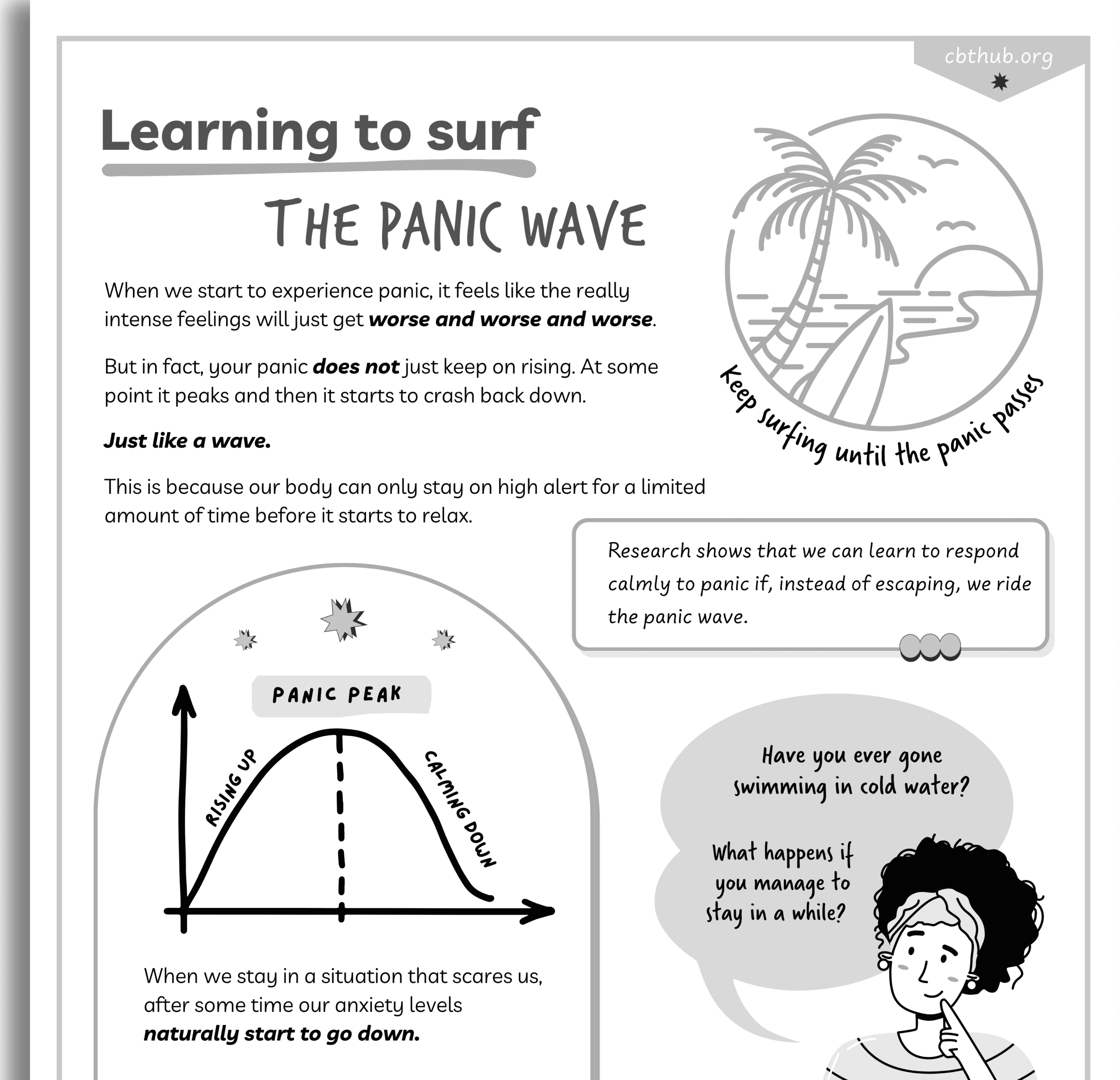
Riding the Panic Wave
This resource introduces the concept of the ‘panic wave,’ to help clients understand the natural rise and fall of panic symptoms. It explains how anxiety peaks and eventually subsides if the young person remains in the situation long enough, allowing the body to naturally return to a calmer state.
This resource is design to support the delivery of graded exposure treatment.

References and Further Reading
- Pincus, D. B., Ehrenreich-May, J., Whitton, S. W., Mattis, S. G., & Barlow, D. H. (2010). Cognitive-behavioral treatment of panic disorder in adolescence. Journal of Clinical Child & Adolescent Psychology, 39(5), 638–649. https://doi.org/10.1080/15374416.2010.501288.
- Peterman, J. S., Carper, M. M., & Kendall, P. C. (2016). Testing the Habituation-Based Model of Exposures for Child and Adolescent Anxiety. Journal of Clinical Child and Adolescent Psychology, pp. 1–11. https://doi.org/10.1080/15374416.2016.1163707.
- Waite, P. (2022). Protocol for a randomised controlled feasibility study examining the efficacy of brief cognitive therapy for the treatment of panic disorder in adolescents (PANDA). Pilot and Feasibility Studies, 8(1). https://doi.org/10.1186/s40814-022-01009-z.
- Hoffman , E. C. , & Mattis , S. G. ( 2000 ). A developmental adaptation of panic control treatment for panic disorder in adolescence . Cognitive and Behavioral Practice, 7 , 253 – 261.
- Micco , J. A. , Choate-Summers , M. L. , Ehrenreich , J. T. , Pincus , D. B. , & Mattis , S. G. ( 2007 ). Identifying efficacious treatment components of Panic Control Treatment for Adolescents: A preliminary investigation . Child & Family Behavior Therapy , 29 ( 4 ), 1 – 23.