


Identifying Safety Behaviours in Panic
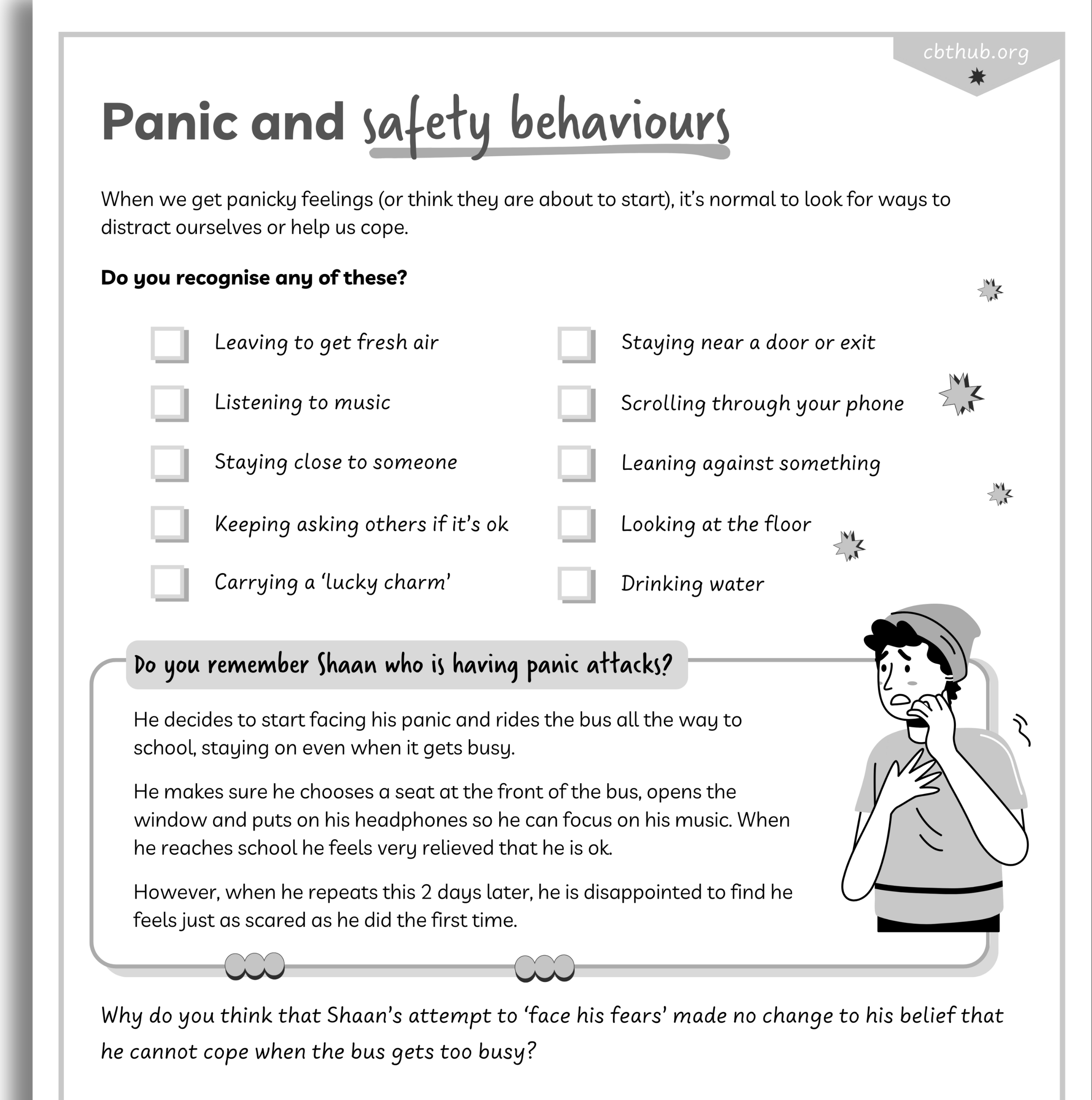
This resource explores the concept of ‘safety behaviours’ in the context of panic and anxiety management. It uses the example of Shaan, a young person experiencing panic on a crowded bus, to illustrate how these habits prevent true habituation and mastery over anxiety.
This resource is design to support the delivery of graded exposure treatment.

References and Further Reading
- Last , C. G. , & Strauss , C. C. ( 1989 ). Panic disorder in children and adolescents . Journal of Anxiety Disorders , 3 , 87 – 95.
- James, A. C., Reardon, T., Soler, A., James, G., & Creswell, C. (2020). Cognitive behavioural therapy for anxiety disorders in children and adolescents. Cochrane Database of Systematic Reviews. https://doi.org/10.1002/14651858.CD013162.pub2.
- Peterman, J. S., Carper, M. M., & Kendall, P. C. (2016). Testing the Habituation-Based Model of Exposures for Child and Adolescent Anxiety. Journal of Clinical Child and Adolescent Psychology, pp. 1–11. https://doi.org/10.1080/15374416.2016.1163707.
- Rachman, S., Radomsky, A. S., & Shafran, R. (2008). Safety behaviour: A reconsideration. Behaviour Research and Therapy, 46(2), 163–173.
- Meyer et al. (2019). Beliefs about safety behaviours in the prediction of safety behaviour use. Published online by Cambridge University Press.