


Understanding Panic Attacks
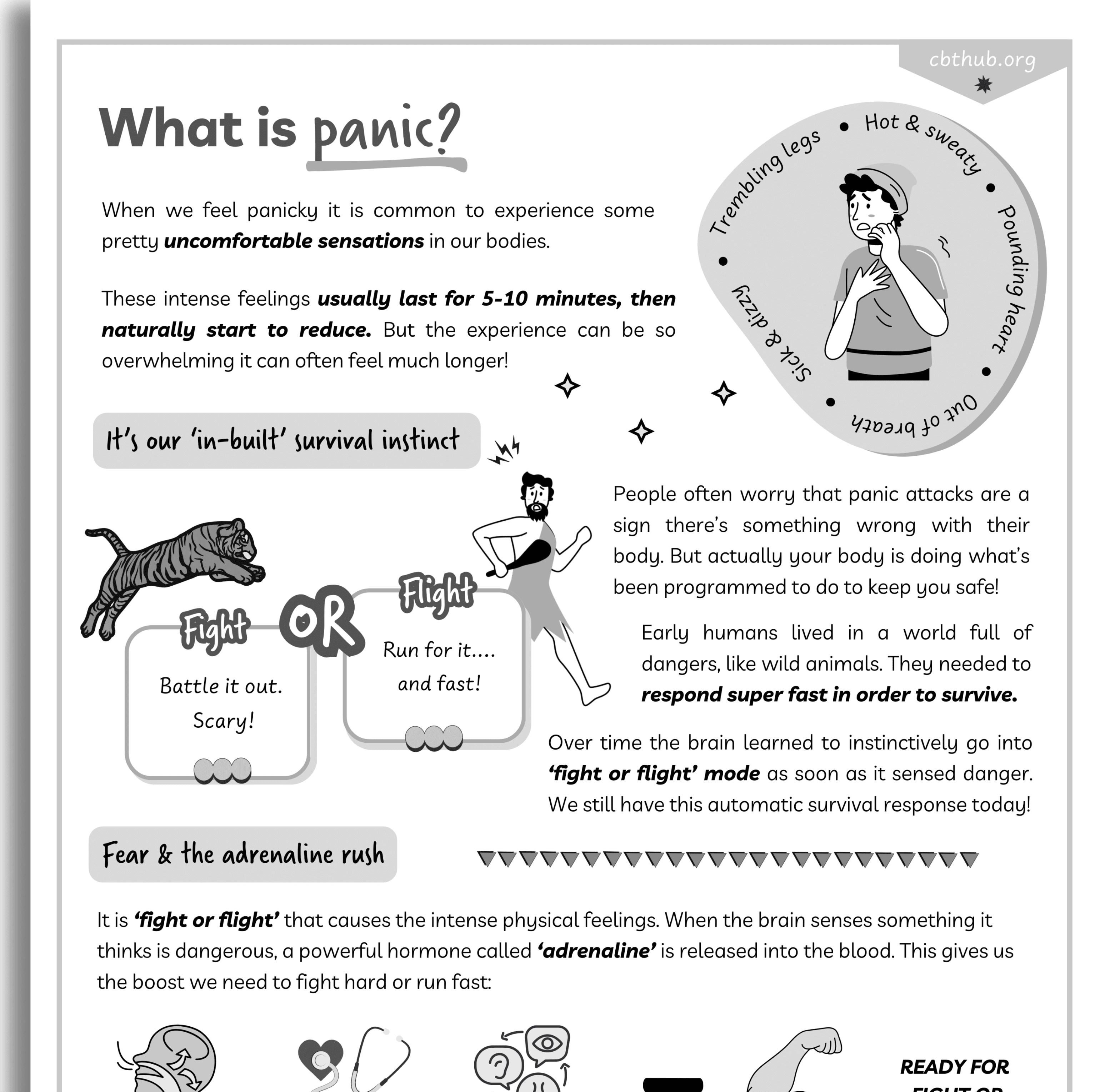
This resource provides an explanation of the physical and cognitive responses that occur during a panic attack, framed within the context of the “fight-or-flight” response.
It’s designed to help therapists deliver psychoeducation about panic, offering insights into how the body’s natural survival instincts can sometimes be triggered in non-threatening situations.

References and Further Reading
- Doerfler , L. A. , Connor , D. F. , Volungis , A. M. , & Toscano , P. F. ( 2007 ). Panic disorder in clinically referred children and adolescents . Child Psychiatry and Human Development , 38 , 57 – 71.
- Last , C. G. , & Strauss , C. C. ( 1989 ). Panic disorder in children and adolescents . Journal of Anxiety Disorders , 3 , 87 – 95.
- Diler , R. S. , Birmaher , B. , Brent , D. Axelson , D. A. , Firinciogullari , S. , et al. . ( 2004 ). Phenomenology of panic disorder in youth.
- Bracha, H. S. (2004). Freeze, flight, fight, fright, faint: Adaptationist perspectives on the acute stress response spectrum. CNS Spectrums, 9(9), 679–685. https://doi.org/10.1017/S1092852900001954.
- Steimer, T. (2002). The biology of fear- and anxiety-related behaviors. Dialogues in Clinical Neuroscience, 4(3), 231–249. https://doi.org/10.31887/DCNS.2002.4.3/tsteimer.
- Keifer, O. P., Jr., Hurt, R. C., Ressler, K. J., & Marvar, P. J. (2015). The physiology of fear: Reconceptualizing the role of the central amygdala in fear learning. Physiology, 30(5), 389–401. https://doi.org/10.1152/physiol.00058.2014.