


How to Use an Activity Diary
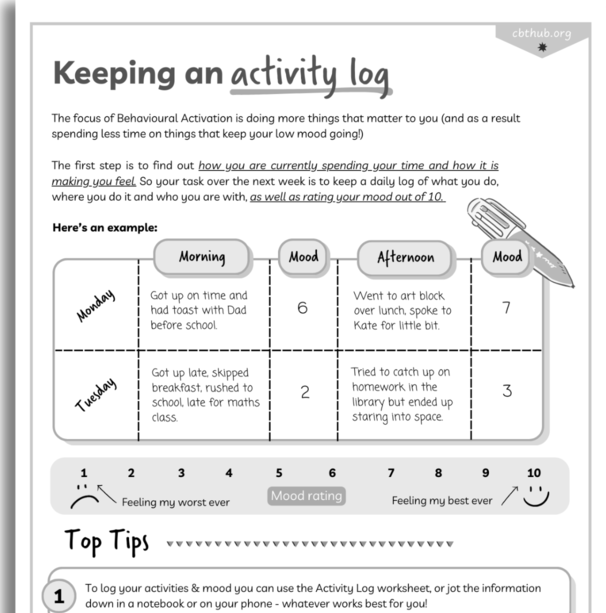
This worksheet is designed to guide young people in completing an activity diary, and hopes to enhance compliance with self-monitoring homework.
Therapists can integrate this tool into their session agenda, particularly during homework setting.
Self-monitoring in CBT increases patient awareness of cognitive, emotional, and behavioural patterns and their links, as well as helping to identify unhelpful thoughts and behaviour (e.g. Cohen et al, 2013).

References and Further Reading
- Pass, L., Reynolds, S., & Pimas, M. (2021). Brief behavioural activation for adolescent depression: A clinician’s manual and session-by-session guide. London: Jessica Kingsley Publishers.
- McCauley, E., Schloredt, K. A., Gudmundsen, G. R., Martell, C. R., & Dimidjian, S. (n.d.). Behavioural activation with adolescents: A clinician’s guide.
- Pass, L., Whitney, H., & Reynolds, S. (2016). Brief behavioural activation for adolescent depression. Clinical Case Studies, 15(5), 360–375.
- Proudfoot, J., & Nicholas, J. (2010). Monitoring and evaluation in low intensity CBT interventions. In Oxford guide to low intensity CBT interventions (pp. 97-104).
- Cohen, J. S., Edmunds, J. M., Brodman, D. M., Benjamin, C. L., & Kendall, P. C. (2013). Using self-monitoring: Implementation of collaborative empiricism in cognitive-behavioural therapy. Cognitive and Behavioural Practice, 20(4), 419–428.